

When people think about wealthy teens in a place like Garden City, they tend to imagine fortunate kids who live protected, comfortable lives. Of course, there is a lot of truth to that. Family wealth can create access to many resources, including high-quality schools, safe neighborhoods, and other resources that many other families do not have.
But research on mental health in affluent communities shows that this isn’t the whole story. Teens in the lowest socioeconomic groups are the ones often recognized as “high-risk.” But research suggests that children of affluent families may face even higher rates of problems like depression and substance use.
As a parent, you can protect your children by arming yourself with the right information and working with a provider who understands the unique challenges that come with your position.
At The Lieberman Center for Psychotherapeutics, we provide integrative psychiatry in Garden City for affluent families who want evidence-based, clinically comprehensive care for themselves or their adolescent children. Book a comprehensive evaluation today.
Common mental health problems among affluent teens
Affluent teens are often surrounded by resources, but that doesn’t make them immune to adolescent mental health problems. Some research has found that children of the affluent may face a higher prevalence of mental health concerns than middle- or lower-class teens.
Substance use
Substance use is one of the top mental health and behavioral health concerns found among affluent teens. Research has found that suburban high school students from high socioeconomic status communities report higher levels of substance use than their inner-city peers, including:
- Cigarettes
- Alcohol
- Marijuana
- Hard drugs
Suburban girls were more likely to report ever using alcohol than the national average, and suburban boys reported higher illicit drug use than national norms.
Some research also found that substance use among affluent teens was linked with depression and anxiety, which could suggest that some teens may use alcohol and drugs to self-medicate. This type of substance use, to manage painful emotions, can be more likely to continue into adulthood (in comparison with “normal” teen experimentation).
Access is also part of the problem. In affluent communities, teens often have easier access to substances. Some research with affluent adolescents described efficient ways wealthy teens obtained alcohol. Binge drinking was seen as a normal part of “partying hard” after working hard.
Anxiety
Anxiety is another concern among affluent teens. In one study, affluent 10th graders reported higher levels of anxiety than inner-city teens, and rates of clinically significant anxiety among affluent boys and girls were higher than the national norm.
Some research found that youth who had high perfectionistic strivings, or who felt that their parents valued achievement over personal character, had higher depression, anxiety, and substance use.
Depression
Depression is also a concern among affluent adolescents, especially among affluent girls. In one study, high-income suburban girls in 10th grade were three times more likely to report clinically significant levels of depressive symptoms compared to normative samples.
Another study found that seventh-grade girls in an affluent community had clinically significant depressive symptoms at twice the rate of normative samples.
These findings don’t mean that affluence directly causes depression. But they do challenge the assumption that family income completely protects teens from emotional pain. Clearly, the relationship between wealth and mental health is complex.
Delinquency and problematic behaviors
Perhaps surprisingly, delinquency and problematic behaviors can also be common among affluent youth.
Research has also found higher rates of delinquency and problematic behaviors among some affluent teens. In one study, nearly one in 10 affluent teenagers showed high levels of behavior disturbance across multiple domains, including substance use and poor academic engagement.
A nationally representative study also found that students attending more affluent schools were more likely to report intoxication, drug use, and property crime. Among boys, the predicted likelihood of property crime increased from 36% in lower-income schools to 58% in more affluent schools.
Unique challenges that wealthy teens face
The mental health risks associated with affluence are not simply about having money. They are often connected to the broader culture of affluence.
This is especially relevant for Garden City and similar communities, where families invest heavily in their children’s education and long-term success. These values are positive, and show how much you care about your child.
But in some cases, they can also create unique pressure that can affect mental health and lead to maladjustment.
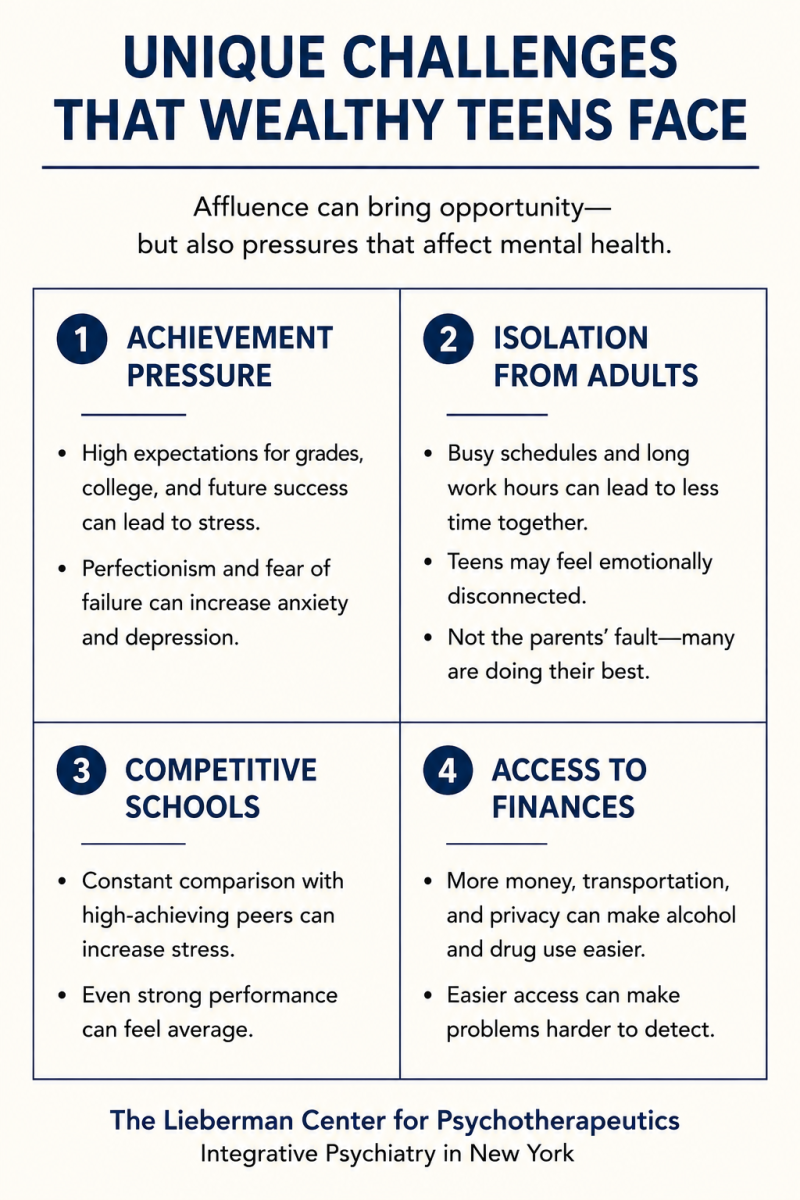
Achievement pressure
Achievement pressure is one of the most studied risk factors among affluent teens. In many wealthy families, teens receive the message that success means excellent grades, getting into the best schools, impressive extracurriculars, and strong future earning potential.
Of course, most affluent parents are just trying to give their children the best opportunities possible. This comes from love, and there’s nothing wrong with it. But when teens feel that achievement matters more than their character or well-being, they may be more vulnerable to mental health issues.
This can be especially intense in competitive schools. Even when no one explicitly tells your teen that they have to be perfect, the environment can still send that message.
Isolation from adults
Isolation from adults is another major factor in the mental health of affluent adolescents. Research has described two types of isolation: literal isolation, such as being home alone after school, and emotional isolation, such as feeling disconnected from parents. Both were linked with distress and substance use.
This is not the parents’ fault, and it does not describe all affluent families. Many wealthy parents work extremely hard because they have demanding careers. You need to maintain financial stability for your family, and that’s respectable. In places like Garden City, many parents are doing everything they can to create a good life for their children.
But even in loving families, time can become scarce. A teen may be busy with tutors, sports, music lessons, and so on. Parents may have long workdays, which understandably leads to limited emotional bandwidth by the evening.
Over time, this can reduce the relaxed family time that many adolescents still need, even when they’re in a developmental stage where they seem more independent.
Competitive schools
Competitive schools can create their own mental health risks. Actually, research on adolescents and young adults from families with high income suggests that school context may matter more than family income alone.
In one national study, attending schools with more affluent schoolmates was associated with a higher likelihood of intoxication, drug use, and property crime.
This does not mean competitive schools are “bad.” There’s a reason why you chose them. They provide excellent education, strong peer networks, and important life opportunities. Unfortunately, they can also create an intense social environment where teens feel constantly evaluated and compared.
When a teen is surrounded by other high-achieving students, even strong performance can feel average. That can affect their psychological well-being and make it harder for them to feel grounded in who they are outside of performance.
Access to finances
Access to finances can also affect mental health and substance use.
It’s a double-edged sword. These resources mean that your child gets the best in private mental health care. But it also means that they may have more money available to buy alcohol and drugs.
Your teen may also have access to things like cars, private spaces, unsupervised homes, and peer networks where substances are readily available.
What you can do as a parent
If you’re an affluent parent and you’re worried about your teen, the first thing to know is that you do not need to blame yourself.
Every parent is doing their best, and it isn’t your fault that the competitive culture surrounding your child can sometimes lead to unique challenges. You have done so much for your child already, and it’s normal to grieve or feel frustrated when it feels like it’s not enough.
But you also shouldn’t try to handle these clinical health conditions alone. Depression, anxiety, substance abuse, and other mental health issues require health treatment. Most of the time, it’s not just about better discipline or more family rules.
Some steps that may help include:
- Pay attention to changes in sleep, mood, grades, friendships, motivation, and substance use patterns. These warning signs can let you know that your child needs more support.
- Ask direct questions about alcohol and drug use without assuming your teen will volunteer the information. Keep the conversation open so that your teen can be honest. Create clear expectations and boundaries to keep them safe.
- Protect regular family time, even if it’s brief. Feeling isolated from adults can be one of the top risk factors for mental health concerns among these youth.
- Take any signs of mental health issues seriously, even when your teen still looks successful on paper. Just because your teen continues to be able to function well doesn’t mean they aren’t suffering.
- Work with a psychiatrist or private mental health team that understands adolescent development and the unique context of affluent families.
Mental health care for wealthy families needs to address these unique mental health concerns
Affluent parents often throw every available resource toward helping their children, and that can be a very good thing. You’re deeply committed to finding the best possible care for your child, and that shows love and dedication.
But it’s also important to keep in mind that more care does not always mean better care. Mental health treatment should be based on clinical evidence, not just reputation or the promise of a quick solution.
Integrative mental health care looks at the full picture of what’s going on. For an adolescent, that may include:
- Psychiatric symptoms
- School stress and performance
- Behavioral concerns
- Sleep
- Nutrition
- Physical health
- Medication needs
- Family relationships
- Social environment
This kind of care can help parents understand what is happening clinically, instead of seeing the problem only as defiance or “typical teen/rich kid behavior.”
Mental health in affluent teens can hide behind achievement. A teen may be accepted into the top schools, get the best grades, be a top performer in their sport, have lots of friends — and still be struggling with clinically significant anxiety and depression or substance use.
Effective care has to address both the symptoms and the context around them.
The Lieberman Center: Integrative Psychiatry in Garden City, NY
The Lieberman Center for Psychotherapeutics provides integrative psychiatry in Garden City, NY for affluent families seeking clinically rigorous, evidence-based mental health treatment.
We work with families who want care that looks beyond symptoms alone and considers the full clinical picture.
For teens in wealthy families, a treatment plan may include:
- Psychiatric evaluation
- Blood panel and biomarker assessment
- Medication management when appropriate
- Referrals to parent coaching
- Coordination with therapists
- Recommendations for higher levels of care when needed.
If your adolescent is struggling with substance use, depression, anxiety, or behavioral health concerns, The Lieberman Center can help you understand what’s happening and guide you through the treatment process.
Get in touch with us today to book a free consultation. We’re here to walk you through the process of evaluation and treatment.