

Executive burnout is often framed as an emotional problem, but that isn’t the full picture. Chronic stress doesn’t only affect the mind. Over time, it can affect your body’s biological systems, including sleep, inflammation, cardiovascular function, metabolism, and more.
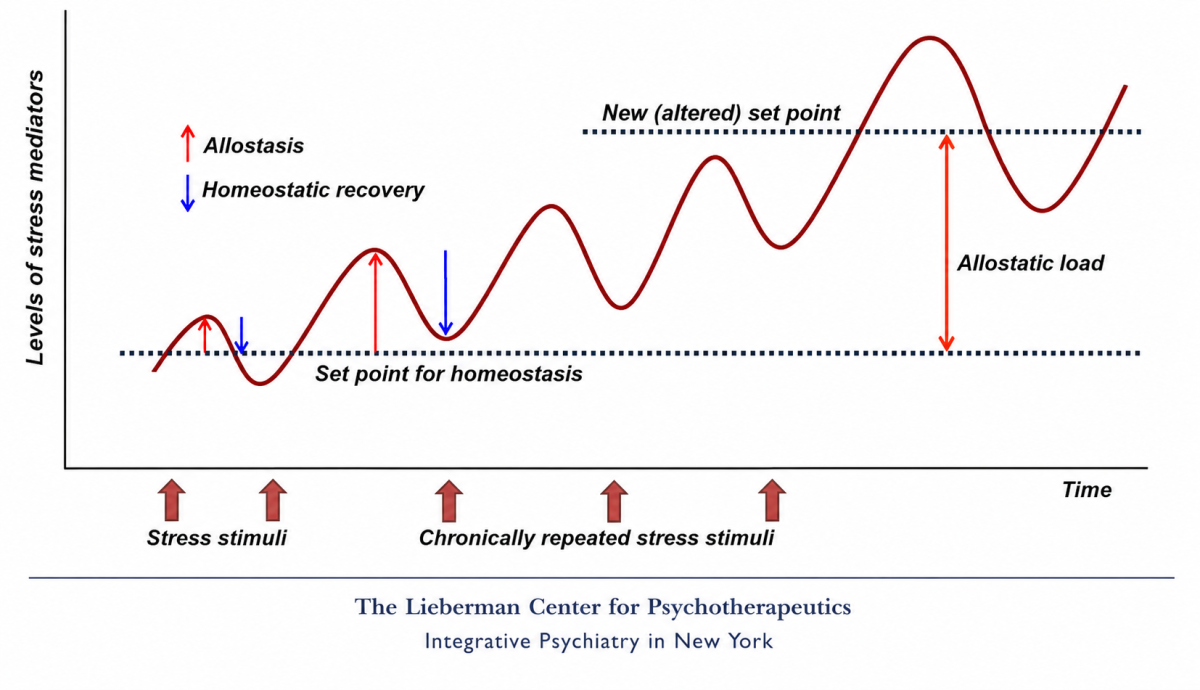
The concept of “allostatic load” helps explain how this happens. Allostatic load refers to the cumulative wear and tear that builds when the body keeps adapting to stress without enough time to recover. You may still be working and performing well — but your body is under a level of strain that’s no longer sustainable.
Research on the effects of allostatic load gives us a scientific way to understand executive burnout and job-related stress. It helps explain why chronic stress can eventually affect how you think, sleep, make decisions, and tolerate pressure.
At The Lieberman Center for Psychotherapeutics, we look at both mental health symptoms and the biological factors that may be contributing to them. A comprehensive evaluation may include a blood panel review when clinically appropriate to get below the surface-level picture. Schedule an appointment to start integrative psychiatry in Garden City, New York.
Allostatic load definition
Allostasis is your body’s ability to maintain stability through change. When you’re under pressure, your body adjusts so you can respond to the stressor effectively.
For example:
- Your heart rate may increase
- Stress hormones like cortisol may rise
- Your brain may become more alert
- Your senses may become sharper
This is not always necessarily harmful. In the short term, these changes can help you perform under pressure.
Allostatic load is what happens when your body’s stress response is activated too often or for too long. The body can keep adjusting, but the repeated adjustment comes at a cost. Over time, this can create strain across multiple systems, including the:
- Cardiovascular system
- Immune system
- Metabolic system
- Nervous system
- Neuroendocrine system
One challenging week might be manageable if you get enough recovery afterward. But when constant stress becomes your “normal,” your body may not have enough time to return to a state of balance.
Allostatic overload is what we call the point when that strain becomes clinically significant and starts to affect your health and functioning.
It’s not a formal psychiatric diagnosis, and we’re still learning more about it. It’s more of a way to understand how prolonged stress can have very real consequences, both physically and mentally, over time.
How allostatic load affects health and performance
Research has linked higher allostatic load with poorer health outcomes across the board. Studies show that higher allostatic load is linked with:
- Work-related stress
- Burnout (in some samples)
- Poor sleep
- Cognitive decline
- Memory and attention deficits
- Cardiovascular disease
- Mental health issues like anxiety and depression
- Higher risk of suicide
For executives, allostatic load matters because high-level work depends on the same systems that are affected.
Effective leadership requires skills like strong focus, sound judgment, emotional regulation and equanimity, and the ability to adapt under pressure. Those abilities depend on the foundations, like good sleep quality and sharp cognition, that are directly damaged by allostatic overload.
For a busy executive, this may not feel dramatic at first. You may still be able to perform, but the same level of output takes more effort. And over time, pushing yourself harder and harder can worsen the physiological burden that’s already been building.
The biological link between allostasis and burnout
The research on burnout and allostatic load isn’t perfect. Many large studies have found a connection, but others have not. That doesn’t mean the concept is weak, it just means burnout is complex.
Allostatic load can be linked to burnout through multiple pathways. Over time, chronic stress can disrupt a wide range of biological systems, such as:
- The hypothalamic-pituitary-adrenal (HPA) axis
- Autonomic nervous system
- Inflammatory pathways
- Cardiovascular function
- Metabolic regulation
The brain is central to this process. Chronic stress can affect different areas of the brain, including:
- The hippocampus, which helps regulate the stress hormone response
- The prefrontal cortex, which is responsible for executive functions (things like reasoning, decision-making, self-control, etc.)
- The amygdala, which is involved in threat detection
These effects on the brain mean that it can become harder to think clearly, regulate your emotions, and make quick decisions under pressure — all of which affect your work performance and relationships. Ordinary work demands can start to feel more urgent or threatening than they would in a recovered state.
This is the how allostatic load and executive burnout are linked. The body keeps adapting to pressure, but the adaptation itself becomes costly.
Over time, the systems responsible for recovery, cognition, mood regulation, and physical health can become less flexible, which can affect both your well-being and your performance.

Signs you’re experiencing allostatic overload
Allostatic overload can look different from person to person. But in high-performing adults, it often appears as a gradual reduction in capacity. You might not experience a dramatic change. You may still be productive, but in reality, there’s less and less space between you and the edge.
Common signs include:
- You don’t feel restored after rest. Time off may help briefly, but it doesn’t last. You’re tired all the time.
- Your sleep is getting worse. You may feel exhausted during the day but alert at night. You may wake up at night thinking about work.
- Your thinking feels less sharp and efficient. Decisions may take more effort. You may notice more trouble with focus or memory.
- Your body is sending stress signals. Chronic stress can show up as headaches, muscle tension, digestive problems, chest tightness, higher blood pressure, or more frequent illnesses. (These symptoms should always be evaluated medically, especially chest pain or cardiovascular changes.)
- You are more irritable or emotionally flat. You’re snapping at coworkers or your partner. You may also feel less connected to work that once felt meaningful.
- Your usual coping strategies are no longer working. More discipline or caffeine may keep you moving temporarily, but they don’t address the underlying stress physiology.
You may have already noticed that these signs look a lot like common burnout symptoms. And they’re worth taking seriously, especially when they appear together and continue despite attempts to recover.
How integrative psychiatry can help
Allostatic overload rarely affects only one part of life. It affects mood and sleep at the same time; work performance and physical health at the same time. It’s essential to “zoom out” and look at the whole picture during psychiatric treatment.
Traditional psychiatric treatment tends to miss that bigger picture.
Medication can be important, and for some people, it’s an essential part of treatment. But it can’t be the final solution. Especially if chronic stress is also affecting sleep, medical risk factors, lifestyle habits, or cognitive performance, then medication alone may not be enough.
Integrative psychiatry looks at mental health in context. We evaluate your current symptoms alongside factors like medical history, sleep, work demands, medications, stress exposure, and biological factors that may be contributing to the problem.
Allostatic load is reflected in biomarkers across the body, related to:
- Inflammation
- Blood pressure
- Blood sugar regulation
- Cholesterol patterns
- Cortisol activity
- Body composition
- Immune function
Running comprehensive evaluations can help you understand allostatic load and how it may be showing up for you.
Start integrative psychiatry in New York (Garden City and Manhattan)
The Lieberman Center for Psychotherapeutics is an integrative psychiatry practice in New York. Our process begins with a comprehensive evaluation. We look at your symptoms in context, including how chronic stress may be affecting your health and performance.
Our psychiatric evaluations also include a blood panel, where we can look at specific biomarkers.
An allostatic load index isn’t a clinical diagnosis or a specific number. It’s more of a way to understand your symptoms and experiences. These biomarkers can give us insight into how chronic stress might be affecting your physical and mental health.
If burnout is starting to affect you, schedule an evaluation to develop a treatment plan that goes beyond short-term symptom control. We have office locations in Garden City and Manhattan.