
New York is known around the world as the “city that never sleeps,” and it turns out we’ve earned that title.
Many NY residents don’t get enough sleep. It can sometimes feel like our city runs on pure energy and long hours — but that fast pace comes at a cost. Sleep can often become something you try to fit in rather than prioritize, especially if you work in a high-pressure role.
It’s okay not to get perfectly restful sleep every single night. But ongoing sleep problems are not something to ignore. Over time, poor sleep can affect your focus and your mood. It can also impact your ability to perform at a high level, which can have long-term effects on your career growth.
If life in New York has made it feel impossible to get the restful sleep you need, we can help. The Lieberman Center provides integrative psychiatry and insomnia treatment in New York. We’re here to help you get to the root of your sleep problems. Get in touch to schedule a free consultation.
New Yorkers aren’t getting enough sleep
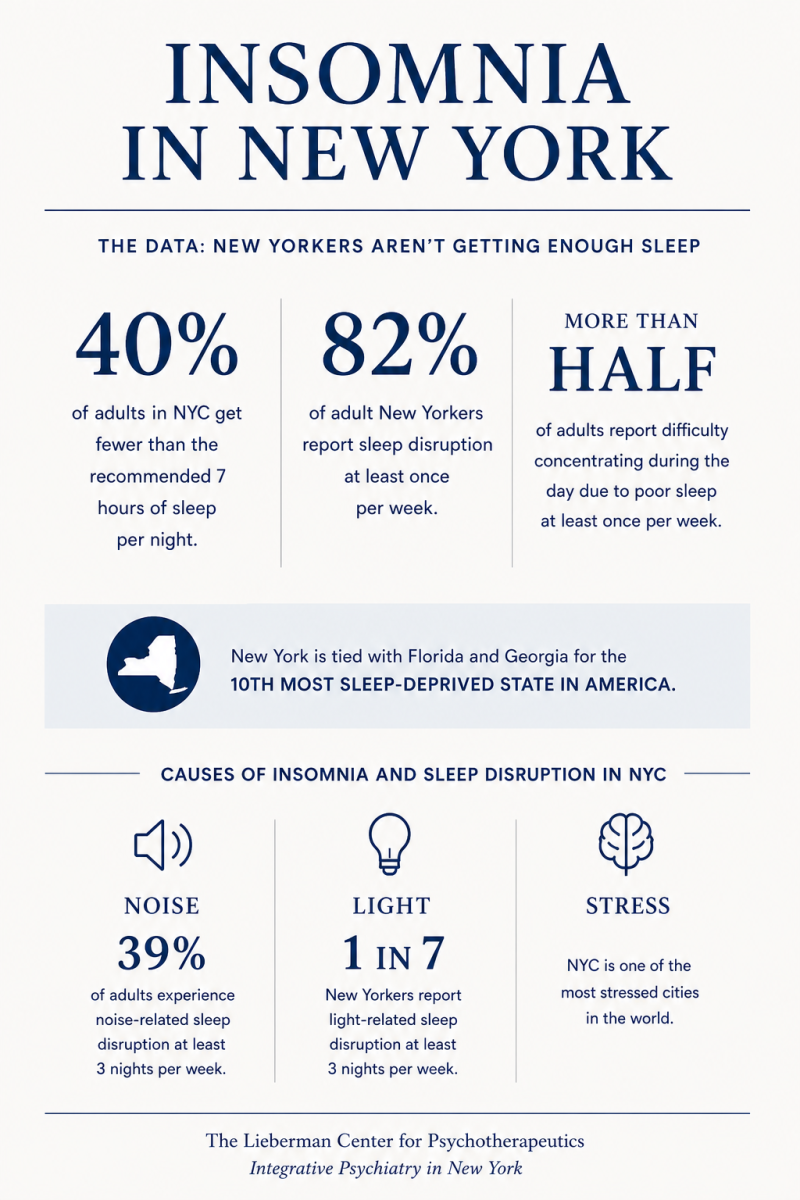
Sleep deprivation is extremely common in NYC, and the data reflects how widespread this problem is. According to current state data, nearly 40% of adults in the city are sleep deprived, or get fewer than the recommended 7 hours of sleep per night.
That means over 1 in 3 New Yorkers are functioning without enough rest on a consistent basis. We’re tied with Florida and Georgia for the position of 10th most sleep-deprived state in America.
Data compiled by the city’s government in 2017 shows that 82% of adult New Yorkers reported experiencing some form of sleep disruption at least once per week. That includes difficulty falling asleep or waking during the night, both of which interfere with sleep and reduce overall sleep quality.
The same data showed the serious impacts that this sleep deprivation has on NY residents’ waking lives. More than half of adults reported difficulty concentrating during the day due to poor sleep at least once per week. That can translate into declining performance at work or impacts on relationships.
Causes of insomnia and other sleep disorders in NYC
Understanding insomnia in New York means looking at how different factors combine to disrupt sleep patterns over time. There are unique factors in New York, especially in the city, that make getting restful sleep especially challenging.
Noise
Noise is one of the most consistent contributors to sleep disruption in New York. More than one-third of New Yorkers — about 39%, or an estimated 2.5 million adults — report frequent noise-related sleep disturbance (defined as having sleep disturbed by noise at least three nights per week).
The most commonly reported noise disruption is noise from neighbors. But other sources include traffic, garbage trucks, buses, nearby restaurants/bars, and emergency vehicle sirens.
Light
Light exposure also plays a role. Nearly one in seven New Yorkers reports sleep disruption from light at least three nights per week. Artificial light (like city lights) can suppress melatonin production, which makes it harder to get to sleep.
Stress
NYC has been dubbed the “most stressed city in the world.” So it makes sense that stress-related insomnia is also common here.
Long working hours and high-pressure environments can keep your nervous system activated, even when you’re off the clock. This can make it difficult to transition into rest, even if you’re exhausted. Racing thoughts at night are also common for people with insomnia, and these worries often revolve around work.
Understanding insomnia: The core symptoms of sleep disorders
There are many different types of sleep disorders, including conditions like obstructive sleep apnea and restless leg syndrome. But insomnia is by far the most common, and it often develops gradually rather than all at once.
Per the Diagnostic and Statistical Manual of Mental Disorders (DSM), the symptoms of insomnia include:
- Difficulty falling and staying asleep, even when you feel tired
- Waking up during the night and struggling to fall back asleep
- Waking up earlier than planned and not being able to return to sleep
- Poor sleep quality, which causes you to wake up groggy and tired even if you’ve technically slept enough hours
- Excessive daytime sleepiness that affects focus
- Irritability or lower stress tolerance
Many people experience insomnia as a result of another condition, like anxiety. But you can also experience primary insomnia, where sleep problems develop without a clear medical condition.
Not sure if you’re experiencing insomnia or another sleep disorder? Get a comprehensive psychiatric evaluation to start getting answers. The Lieberman Center for Psychotherapeutics is an integrative psychiatry practice providing insomnia treatment in New York. Book an appointment today.
Effective treatment for insomnia
Effective insomnia treatment usually requires more than a single intervention. Treating sleep involves identifying the root causes and building a structured treatment plan that addresses them directly.
An integrative psychiatry approach looks at sleep as part of a larger system rather than an isolated symptom. That includes your stress levels, your daily routines, your biological rhythms, and any underlying medical conditions that may be affecting sleep. Without understanding these root causes, treatment can become surface-level and ineffective.
Here are some of the integrative methods that can be used.
Sleep hygiene training
Sleep hygiene training focuses on helping you build daily habits that support healthy sleep, both during the day and at bedtime.
In New York, this often includes managing external disruptions like noise and excess light. White noise machines or earplugs can reduce the impact of noise that would otherwise interfere with sleep. Blackout curtains can help limit light exposure, which supports melatonin production.
A mental health provider can also walk you through other helpful sleep habits, like staying away from screens before bed and teaching you what to do if you find yourself tossing and turning.
CBT-I (Cognitive Behavioral Therapy for insomnia)
Cognitive behavioral therapy for insomnia (CBT-I) is considered the gold standard for chronic insomnia and is recommended by the American Academy of Sleep Medicine as a first-line treatment.
CBT for insomnia focuses on changing the thoughts and behaviors that interfere with restful sleep. Many people develop patterns that unintentionally reinforce insomnia. Often, the thoughts you have around insomnia itself — like “I need to wake up in 5 hours, and I’m going to be so tired in the morning. Why can’t I just fall asleep?” — can make it even harder to sleep.
CBT-I works to retrain these patterns. It includes sleep hygiene techniques that strengthen the connection between your bed and sleep, while also addressing cognitive factors like racing thoughts.
Medication treatment options
Integrative psychiatrists may prescribe medication in some cases, particularly when symptoms are severe and are getting in the way of your functioning. But it’s important to understand that it’s never a standalone solution.
Medication is best seen as a short-term solution rather than a complete answer. Sleep aids may make it easier to fall asleep in the moment, but they don’t typically address the patterns that led to insomnia in the first place. Over time, this can lead to ongoing reliance without any real improvement in sleep quality.
Lifestyle changes
Lifestyle factors play a significant role in sleep quality. Making and committing to changes can help you improve the quantity and quality of your sleep.
For example, caffeine intake can delay your ability to fall asleep, especially when consumed later in the day. Alcohol may initially make you feel drowsy, but it can disrupt deeper sleep stages. Getting regular physical activity can improve sleep quality when it’s timed earlier in the day.
Sometimes, making small changes like this can make a big difference in improving your sleep.
Get integrative insomnia treatment in New York
Insomnia and sleep disorders rarely have a single cause. Effective insomnia care requires a comprehensive approach that focuses on both biological and psychological factors.
The Lieberman Center for Psychotherapeutics provides integrative psychiatry and insomnia treatment in New York. We focus on providing evaluation and treatment that identifies the root causes of insomnia and creates a personalized treatment plan tailored to your needs.
Our founder, Brad Lieberman, is a board-certified psychiatric nurse practitioner who has worked as an attorney in New York and understands what it’s like to deal with sleepless nights.
We also coordinate with sleep specialists and, when needed, we can refer you to a center for sleep medicine for further testing, such as overnight sleep studies. This can help diagnose and treat other medical conditions that may be affecting sleep.
Our goal is to restore healthy sleep and improve your ability to wake feeling rested. If you are dealing with chronic sleep issues, effective treatment is available.
Get in touch with our team to schedule a comprehensive psychiatric evaluation. We have office locations in Manhattan and Garden City (Long Island).