

Being a good leader isn’t just about being intelligent or skilled at your job. Mental endurance — also known as mental toughness — is one of the most important assets that business leaders can have, and it’s not talked about nearly enough.
When you’re under such high levels of pressure, your ability to think clearly and stay grounded becomes one of your most valuable skills. Mental endurance gives leaders the internal capacity to keep going through even the most challenging of times.
It’s what separates reactive leadership from strong leadership. And working with a mental health provider can help you develop, and protect, this asset.
Do you have what it takes to be an enduring, confident leader? Mental health care can be a powerful tool for building your leadership skills. Book a free call with The Lieberman Center for Psychotherapeutics — now offering integrative psychiatry for high-performing professionals in New York.
Defining mental endurance
The concept of mental endurance is most often discussed in sports. It may also be called mental toughness or psychological resilience.
These ideas (resilience and endurance) are closely related, but they are slightly different. Resilience often refers to how you recover after a setback. Endurance refers to how you keep going while the pressure is still active. It’s the ability to stay engaged when the work feels difficult or uncomfortable.
There’s no universally accepted definition of mental endurance in psychology. But one study described it as a set of psychological qualities that allow people (athletes, in the mentioned study) to maintain performance during demanding conditions.
Just like physical stamina helps you keep going when you’re exhausted or in pain, mental endurance helps you maintain through psychological adversity.
Mental endurance can include the ability to:
- Keep performing in challenging situations
- Feel confident under pressure
- Stay stable when the stakes are high
- Cope effectively with obstacles
- Stay connected to a specific goal even when current demands are overwhelming
- Make sound decisions under pressure
- Look confident when the situation feels difficult
- Manage discomfort without losing hope or direction
Mental endurance is also closely tied to emotional regulation, a key part of emotional intelligence. You may feel frustration, fear, anger, or fatigue, but you’re able to manage these emotions. You don’t allow emotions to sidetrack you from your goals.
What are the 4 Cs of mental toughness?
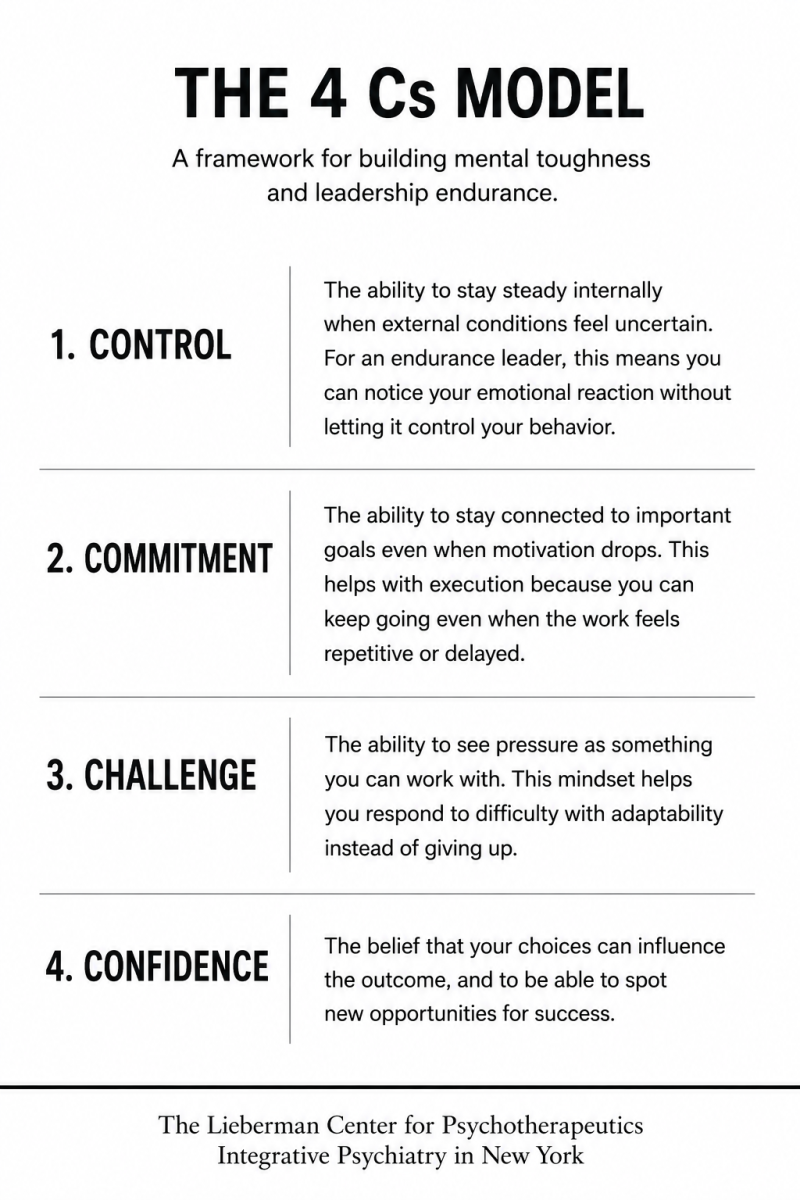
A common framework for approaching mental toughness is the 4 Cs model, developed by psychology researcher Peter Clough. This four-part model is often used in performance psychology, but it also applies to leadership endurance.
- Control: The ability to stay steady internally when external conditions feel uncertain. For an endurance leader, this means you can notice your emotional reaction without letting it control your behavior.
- Commitment: The ability to stay connected to important goals even when motivation drops. This helps with execution because you can keep going even when the work feels repetitive or delayed.
- Challenge: The ability to see pressure as something you can work with. This mindset helps you respond to difficulty with adaptability instead of giving up.
- Confidence: The belief that your choices can influence the outcome, and to be able to spot new opportunities for success.
The good news is that these qualities can be trained. Some leaders build them through experience. Even if you don’t feel like they come to you naturally, you can work with a coach, therapist, psychiatrist, or leadership expert who can help you understand your strengths and how you can continue developing yourself.
Why endurance in leadership matters
In leadership, mental toughness becomes especially important because pressure usually lasts longer than a single event.
It’s not just one marathon you need to get through. A difficult quarter, an evolving market, a long-standing conflict inside the company, a demanding negotiation or merger — all of these things can keep your nervous system activated for long periods of time. And you need to endure through it all.
Here are some of the biggest benefits of mental endurance for leaders.
Protection against stress and burnout
The pace that many leaders are expected to keep up with can quickly become unsustainable. Reports show that up to 70% of C-suite executives face symptoms of executive burnout.
Research shows that mental endurance can help protect you against many of the effects of intense stress and burnout. You’re also less likely to develop mental health problems in response to stress when you’re mentally tough. If you want to build a legacy and sustain your success long-term, mental endurance can help you get there.
Harden yourself against executive burnout. Make an appointment at the Lieberman Center, specializing in integrative psychiatry for high-net-worth individuals in New York.
High-stakes decision-making
High-stakes leadership often requires you to make strategic business decisions before all the information is available. The pressure may come from investors, employees, clients, or the board of directors.
Mental endurance can help you stay steady in the face of constant change and adversity. You can pause long enough to evaluate the facts and leverage your experience to make the most grounded decision. When poorly thought-out decisions do get made, you’re able to stay resilient and bounce back.
Staying focused on the most important goals
Leaders are constantly being pulled toward urgent demands. Without enough mental capacity, it becomes easy to spend all day simply putting out whatever fire is burning at that moment.
Mental endurance allows you to stay focused on long-term goals, regardless of what else might be going on. This, in turn, supports productivity and better business results, because your attention and efforts are always tied to the work that matters most.
Influencing your team and stakeholders
People take cues from the person in charge. The way you present yourself can either increase tension or empower people to feel more secure and confident.
Mental endurance can help you inspire confidence without overexplaining yourself. You’re in a better position to cultivate trust with your workforce and maintain credibility with stakeholders. This ability is such a big part of what makes a great leader.
Being open to change and opportunity
Mental endurance allows you to be more optimistic and adaptable. When you’re mentally tough, you’re able to see the opportunity for growth rather than seeing change as a threat. You’re able to respond to the inevitable curveballs without becoming rigid and defensive.
Emotional equanimity
Emotional equanimity means you can feel what is happening without becoming controlled by it. This skill is essential in the face of adversity, especially when you’re leading a company or team.
Emotional intensity can spread quickly through an organization. A steadfast leader can help create clarity in executives and teams, especially during times of conflict and negotiation.
Mental health care can set you apart as a leader
Mental health care belongs in a high performer’s self-development plan.
Therapy and psychiatry aren’t only for people in a crisis or living with a mental health condition. For people like you — executives, founders, physicians, attorneys, and other organizational leaders — the goal of care is mental health optimization.
In other words, it’s more than just about eliminating distress. It’s about performing at your best.
The right mental health support can help you build strong coping skills, including mental toughness. These are skills that can be trained and practiced. Seeing a mental health provider can help you:
- Strengthen the cognitive muscles that help you stay grounded and resilient
- Improve focus and clear thinking
- Reduce chronic stress and your allostatic load so you’re not facing your next challenge in a place of depletion
- Improve sleep so that your brain has more capacity for reasoning and judgment
- Practice emotional regulation in real time
Integrative psychiatry can also help you understand the connection between your mind/body and your leadership performance. Sleep, stress physiology, mood, attention, and health data can all affect the way you work and lead. Your mental health doesn’t exist in a vacuum.
Mental health support is what could set you apart as a leader, both now and in the future. It can create the optimal internal conditions for long-term leadership success.
Get integrative psychiatry for high performers in NYC & Garden City
The Lieberman Center for Psychotherapeutics provides integrative psychiatry for high-performing professionals in New York City and Garden City.
Our work is designed for people who carry significant responsibility in their professional lives, and are looking for a deeper level of care. We use a range of tools to look at the full picture of your mental health, physical health, performance demands, and life context. The treatment you receive should always make sense for the reality of how you live and lead.
If you are ready to strengthen your cognitive capacity and build lasting performance as a leader, contact The Lieberman Center for Psychotherapeutics to learn more about integrative psychiatry in New York. We’re here to help you become the great leader you know you can be.