

Receiving an inheritance is often framed as something to simply feel grateful for. People view wealth as a blessing, and in so many ways, it is. From the outside, it’s easy for everyone to assume that the only appropriate emotional reaction is appreciation.
But the emotional reality is usually much more complex, both for people who are receiving the inheritance as well as those who are bequeathing it. Inheritance tends to come with the heavy weight of practical responsibility. It also often comes at the same time as grief, which adds another complexity.
Here, we’ll talk about the psychological aspects of inherited wealth, and how to manage them with grace for yourself and others.
The Lieberman Center for Psychotherapeutics helps affluent families navigate the emotional process of inheritance with comprehensive, discreet psychiatric care in New York. Get in touch with us to schedule an evaluation.
Understanding the psychological impact of inherited wealth
Understanding the psychological impact of inherited wealth means looking at both sides of the transfer. This process can affect both the recipient as well as the donor. The emotional and psychological challenges of inherited wealth are real, and they need to be addressed with the same seriousness as the legal and financial aspects.
Here are some of the biggest psychiatric complexities that can come along with this process.
For the recipient
Many recipients feel pressure to respond “correctly” to inheritance. They may feel grateful in one moment, then anxious or ashamed in the next. The truth is that there’s no “right” way to feel.
Many people who’ve received an inheritance feel emotions like:
Guilt
Guilt is a common reaction to inherited wealth. Some people feel guilt because they are gaining financial security through someone else’s death. Others may feel guilty about wealth disparity compared to their friends or in general, and have thoughts like, “Why do I have so much while others have so little?”
These feelings of guilt can sometimes lead to poor financial decisions. Some people give away large amounts quickly, without considering the long-term impact. Others donate impulsively to try to absolve themselves of the guilt. Generosity can be meaningful, but random giving without a strategy can create regret or lead to decision paralysis later.
Lack of purpose
Inherited wealth can also affect a person’s sense of purpose. Research on millionaires has found that people who earned a higher percentage of their wealth reported greater happiness than people whose wealth was mostly unearned or inherited.
For a recipient, a large sum of money can remove certain pressures, but it also creates new questions. What do I work toward now? What do I build? What is the point of my life? Without a clear connection to personal values, wealth may make you feel emptiness rather than freedom.
Worthiness
Worthiness can become especially complicated for an heir. If you inherit a family business or a visible family name, the inheritance may feel like a test you did not choose to take.
Heirs feel pressure to prove they deserve what they received. They may feel like they’re always living in the shadow of their predecessors and worry that they lack the discipline or resilience that created the original success. This can lead to an identity crisis or feelings of worthlessness, especially when they inherit the wealth when they’re young (and still developing their sense of self).
Pressure
Inheriting significant wealth can change someone’s role within the family very quickly. Someone who previously avoided financial decisions may suddenly need to participate in estate meetings or manage property. They may also start to receive pressure from relatives with strong opinions. In some cases, this pressure can lead to anxiety or other mental health concerns.
Pressure can also affect your other relationships. Friends may treat you differently, and family members may become more demanding. Even when the financial resources themselves are welcome, the pressure that almost always comes along with it can significantly impact daily life.
Grief
Lastly, inheritance is often tied to grief. You typically inherit after a parent, spouse, or another loved one dies. That means the financial windfall may arrive during one of the most painful periods of your life. That adds a significant layer of complexity.
The impact of inheritance is different when the money is connected to the loss of a loved one. You’re trying to navigate the process and make decisions while sleep-deprived or emotionally numb. You may feel guilty for receiving something positive out of your loved one’s death. It may even feel like there’s no room for grief because you are too busy dealing with the bureaucracy of wealth transfer.

For the donor
The person leaving wealth behind also often experiences significant emotional strain. It’s common to wonder if your heir is prepared for the financial responsibility. This is especially true if your recipient lives with depression, substance use, or another mental health condition that has affected their stability in the past.
These concerns do not always come from mistrust. Usually, they come from a combination of deep care and realistic awareness. You may know your heir’s strengths better than anyone, but you also know their weaknesses. If they’ve had mental health crises or periods of instability in the past, it makes sense that you might understandably worry about what this newfound wealth could bring up for them.
There may also be grief in recognizing that wealth cannot protect your loved one from suffering. Parents and older family members often hope that inheritance will create safety after they’re gone, but significant wealth can also bring other problems. Or it may simply not be enough to help them overcome whatever they are going through.
This emotional conflict is especially painful because there is no perfect answer. But your concerns are valid, and they deserve to be taken seriously rather than dismissed as overprotectiveness.
What is sudden wealth syndrome?
Sudden wealth syndrome is a term used to describe the distress that can happen after a person receives a sudden windfall (whether it be through inheritance, a business sale, a lawsuit, or another event).
Sudden wealth syndrome is not a formal psychiatric diagnosis, but it can describe a very real experience that many have gone through.
It’s characterized by:
- Anxiety about losing the money or mismanaging it, which may present as sleep difficulties, rumination or excessive worry, physical stress symptoms, etc.
- Guilt about receiving money, especially when it comes through the death of a loved one
- Decision paralysis around what to do with the money
- Fear that other people only want access to your wealth
- Feeling isolated from friends or family who may not understand your new financial status
- Impulsive financial decisions, especially when you feel pressured to “do something” with the money
- Changes in identity and sense of self
There is undoubtedly an added layer of complexity to inheritance when a person has not had access to these resources before. Someone may technically come from a wealthy family, but that doesn’t mean they have experience managing wealth. This can be very anxiety-provoking for many people.
Strategies for managing painful emotions when you receive an inheritance
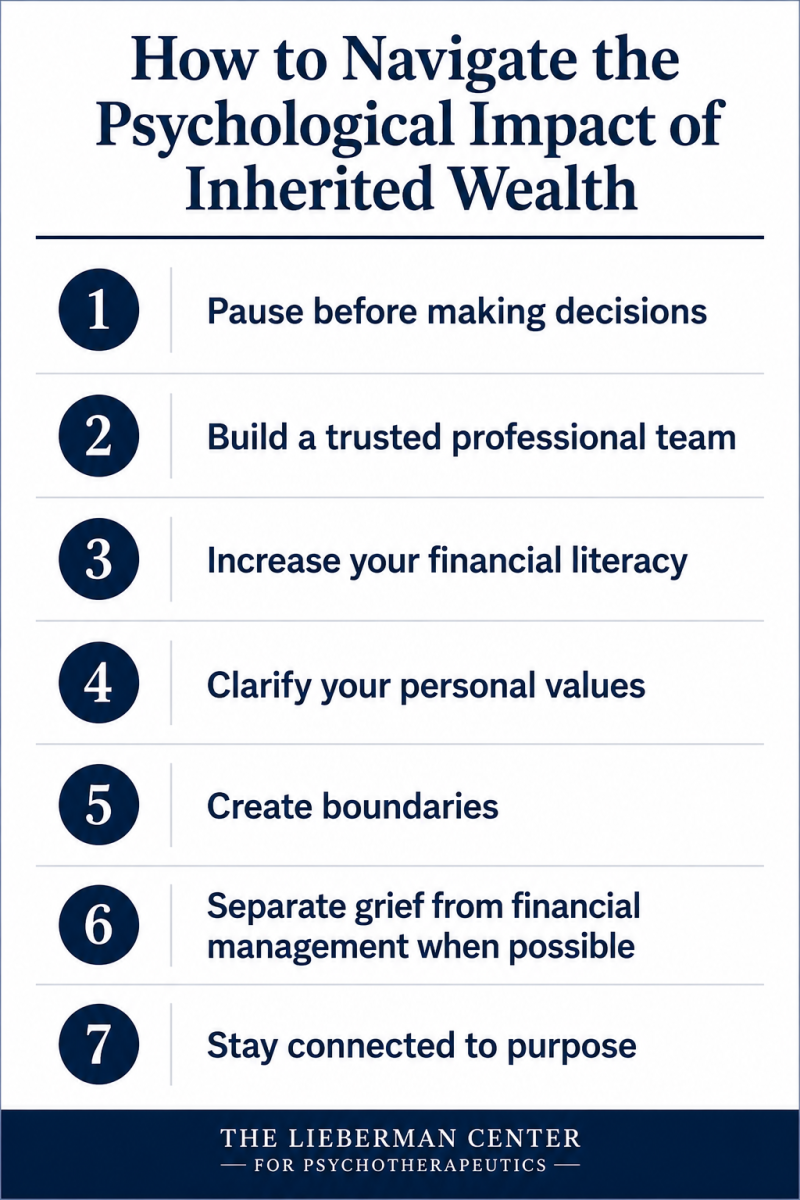
It’s important to address both the emotional and financial reality of the situation. You don’t need to rush into a full life plan immediately. In many cases, the most clinically sound first step is to simply slow down.
These steps can help you navigate the emotional complexities of inherited wealth with more clarity.
- Pause before making major decisions. Unless there is an urgent legal or tax deadline, give yourself time before selling property, giving away money, changing jobs, or making any financial commitment that could affect your future.
- Build a trusted professional team. This typically includes a financial advisor or estate attorney. A psychiatrist or therapist may also be important if the inheritance is affecting your sleep, mood, relationships, or ability to make decisions. A solid team can help you make financial decisions that support your long-term goals.
- Increase your financial literacy. You don’t need to become a wealth management expert overnight. But learning the basics can reduce fear and help you feel more empowered.
- Clarify your personal values. New wealth can make many options available at once that you’ve never had access to before. Values-based planning can help you decide what actually matters to you and define your financial (and personal) goals.
- Create boundaries. Family members and friends may have opinions about what you should do with the money. You may need clear limits around when you discuss finances and who has access to that information.
- Separate grief from financial management when possible. You may need to grieve before you can think clearly. Of course, there may be some things you need to decide immediately. But it may also be important to delay non-urgent choices until your mind and body have had time to process the loss.
- Stay connected to purpose. Wealth stewardship can feel more meaningful when it connects to work, family responsibility, philanthropy, or creative goals that genuinely matter to you.
How integrative psychiatry can help
A psychiatrist may not be the first person you think of when you are dealing with inherited wealth. Many people assume this is a financial problem first, so they seek support from wealth managers or attorneys. Those professionals are essential, but they are not trained in managing the psychological effects of wealth.
An integrative psychiatrist can help when the emotional weight of inherited wealth begins to affect your sleep, mood, concentration, or relationships. Inheritance can bring up grief and anxiety, and it can lead to (or reactivate) family conflict. This can increase chronic stress and your allostatic load. A psychiatrist can assess how these pressures are affecting you as a whole person and find ways to deal with it.
This kind of comprehensive care can be especially important for affluent families because untreated psychiatric symptoms can directly affect financial outcomes. When the psychiatric component is ignored, the consequences often show up in financial life, too. Integrative psychiatry can help address the mental health factors, so wealth decisions are not being driven by anxiety or untreated symptoms.
The Lieberman Center for Psychotherapeutics: Integrative Psychiatry in New York
Inherited wealth can be a welcome gift. But it can also carry grief, pressure, guilt, and responsibility that other people may not fully understand. When your inheritance starts to affect your mental health or relationships, psychiatric care can help you move through the process.
At The Lieberman Center for Psychotherapeutics, our integrative psychiatry services look beyond surface-level symptoms alone. Our comprehensive evaluation includes an assessment of things like your sleep, nutrition, medical history, and more. Through bloodwork, we can look at biomarkers that may indicate high levels of stress.
For some patients, medication may be appropriate. For others, the priority may be therapy, lifestyle changes, family communication, or coordination with other professionals (like attorneys or estate planners).
We provide integrative psychiatry in New York (Garden City and NYC) for affluent families, executives, and other high-achieving professionals. If you are preparing for a wealth transfer or trying to adjust after an inheritance, we can help you understand the emotional impact so that you can make decisions with clarity and purpose.