

BigLaw is one of the most demanding paths in the legal profession. You’ve completed law school and secured a position at a top firm, and have begun a career defined by prestige and high pay.
This is the dream for many people. But that trajectory does not guarantee sustainability. The high rewards also come with high expectations and, for many lawyers, unrelenting pressure.
If you’re managing a heavy caseload and beginning to experience signs of burnout at a big law firm, that response is not unusual. Burnout in BigLaw is well-documented, particularly in New York, where the intensity of large law firms is intensified by the pace of the city itself.
The Lieberman Center for Psychotherapeutics provides integrative psychiatry for lawyers and other high-performing professionals across NYC, Long Island, and Westchester County. Schedule a free consultation to take a closer look at what’s going on behind your burnout.
What BigLaw burnout feels like at an NYC law firm
New York firms like Cravath, Davis Polk, Skadden, and Kirkland & Ellis are known for excellence, but also for demanding workloads and high billable hour expectations. Over time, even highly capable attorneys can begin to feel the effects of that kind of environment.
Lawyer burnout does not often present as a clear breaking point. You might even notice it’s happening until you’re already deep in it.
In many cases, BigLaw associates continue to perform at a high level. You may still be meeting your billable hours and meeting client demands. What changes is your internal experience.
You may notice a persistent sense of exhaustion that is not resolved by time off. Work that once felt like an engaging challenge may now feel mechanical, like you’re doing it on autopilot. Some BigLaw attorneys describe a growing detachment from their work, where they remain productive on the outside but feel more and more disconnected from the deeper meaning of their work.
In NYC, burnout can be even more intense. The expectation of constant availability, combined with long hours and unpredictable deadlines, can create a baseline level of nervous system activation that is difficult to step away from. Over time, that can contribute to emotional exhaustion. You may develop a reduced capacity to recover between work days, even when you take vacation time.
Signs of burnout in lawyers
Burnout among attorneys often develops gradually and can be difficult to identify early.
You may notice signs of burnout that don’t immediately stand out, especially if you’re still meeting expectations at your law firm. Over time, these patterns can become more consistent and harder to ignore.
Some common signs of burnout include:
- Persistent emotional exhaustion, even while you continue to perform at a high level. Even routine and “easy” tasks can feel draining, both at work and at home. Many attorneys feel like they just have nothing left to give.
- A growing sense of cynicism toward your firm or the legal profession in general. You dread going to work every morning and feel strongly that your work lacks meaning.
- Feeling detached from your work, even while maintaining productivity. You might continue to meet bare-minimum expectations, but you’re no longer invested.
- Difficulty concentrating or making decisions that used to feel straightforward.
- Changes in sleep, including trouble falling asleep or waking up feeling unrested.
- Increased irritability, especially in response to minor stressors. This may cause you to lash out at loved ones even when they’re not your true target.
- Relying more on alcohol or other substances after working long hours. It might feel like you can’t get through a day without drinking or smoking.
These signs of burnout can develop even while you continue to perform at a high level, which is part of what makes burnout in BigLaw more difficult to recognize earlier on.
High-pressure legal careers require a different level of mental health care. At the Lieberman Center for Psychotherapeutics, we work with attorneys across NYC, Long Island, and Westchester County to address burnout at its source. Schedule a psychiatric evaluation today.
Causes of burnout in Big Law associates
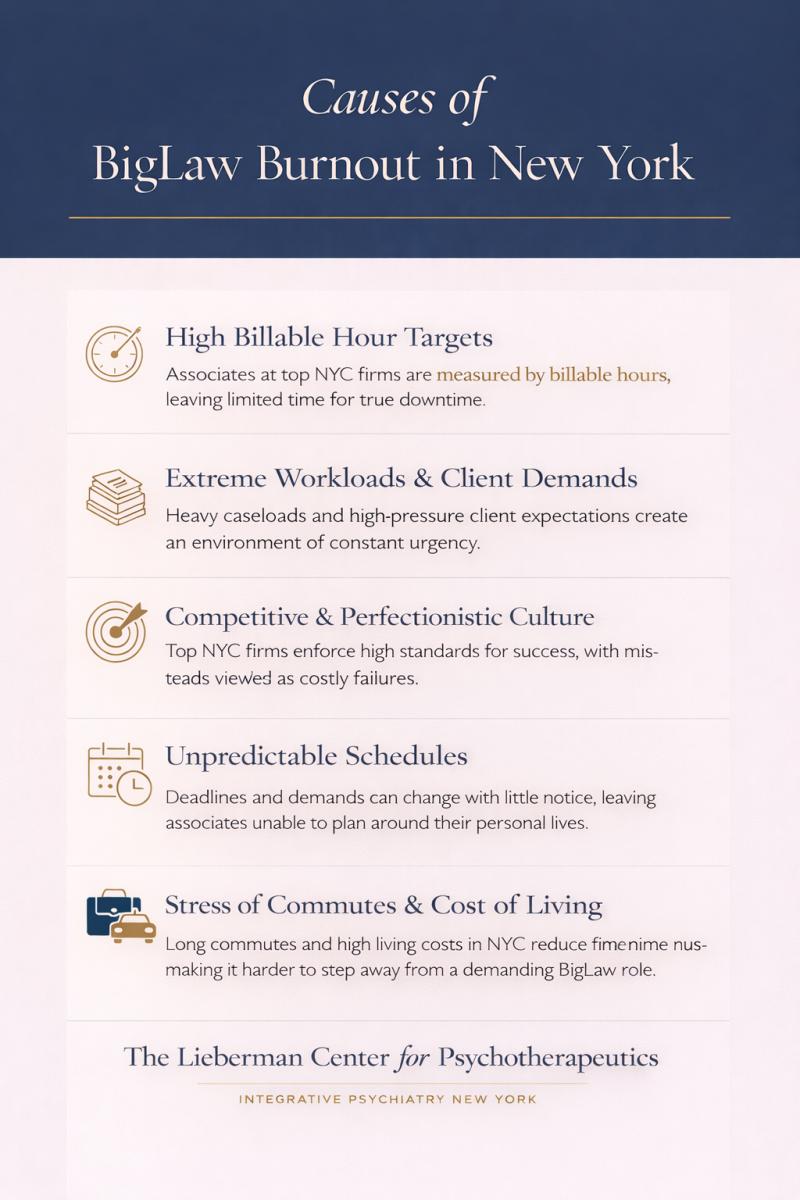
There are so many unique aspects of working at a large NYC firm that directly contribute to attorney burnout. To put it simply, working for these firms often requires you to put the rest of your life on hold. Often, these environments are not designed to support a healthy work-life balance — they are designed to help you progress through a highly competitive and demanding career track.
Here are some specific aspects of this career that make many attorneys feel burned out.
Billable hour targets
Billable hours are an important structural driver of burnout in BigLaw firms.
Your productivity is directly measured through billable time. So it’s no wonder your relationship to work becomes highly quantified. Time is no longer just spent — it is obsessively tracked and evaluated, and is often directly tied to performance and even compensation.
This framework can make it difficult to disengage from work, even outside of office hours. Attorneys often report a persistent awareness of time, where non-billable periods (even during leisure activities) feel like lost productivity.
Competitive work culture
Large law firms, especially in New York, operate within an inherently competitive internal structure. You are working alongside other high-performing attorneys, most of whom are equally committed to advancement.
There’s the constant pressure of maintaining visibility to one day make partner. You need to secure (and succeed in) high-profile assignments. As associates progress, particularly at the mid-level or senior associate stage, expectations tend to increase rather than stabilize. It can often feel like there’s no end in sight.
Unpredictable deadlines and client demands
BigLaw attorneys and associates also often have little to no autonomy over their schedule. It’s unpredictable, and you need to be “on” at all times.
Client demands can arise with little notice. Deadlines may shift quickly, particularly in litigation or complex transactional work. Your workload may become slightly manageable, only to change abruptly again.
This unpredictability makes it difficult to establish consistency outside of work. It also maintains a constant level of psychological pressure.
Perfectionism
Perfectionism is often reinforced within the legal profession.
Attention to detail and high standards are necessary for success, particularly in large law firms. These things are expected of you. However, when those standards become rigid or internalized to an extreme degree, they can contribute to burnout.
Attorneys may feel that all work must be completed without error, regardless of time constraints or workload. Over time, perfectionism becomes less of an asset and more of a source of intense internal pressure.
Stress of commutes and living costs
Practicing law in NYC, specifically, comes with a whole host of additional external stressors.
Daily commutes, particularly on crowded public transit, can be physically and mentally draining. When combined with long hours at a law firm, this can reduce the amount of time you have available for rest and recovery.
The cost of living in New York is higher than in almost any other city. Even with a BigLaw salary (or because of it), you may feel stuck at your current role. You don’t feel like you can leave, even if you hate your job. This can feel like it limits your ability to make a change, like transitioning to an in-house job or leaving the legal industry altogether.
The Lieberman Center for Psychotherapeutics is led by a former attorney who understands firsthand what lawyer burnout actually feels like. We provide integrative psychiatry for lawyers and other professionals in NYC and Garden City — schedule a free consultation to talk through next steps.
How to avoid attorney burnout and achieve work life balance
If you catch the signs of burnout early, you may be able to make smaller changes to deal with it and prioritize your wellness. Here are some tips to consider.
Prioritize strategically within your workload
Not all work carries the same level of impact, even within a demanding law firm environment.
Developing the ability to differentiate between high-priority tasks and those that are less critical can help reduce unnecessary strain. This may involve clarifying expectations with management or approaching assignments with greater selectivity in how time is allocated.
While this does not eliminate workload, it can improve how that workload is experienced.
Maintain your physical health
Managing your physical health can significantly affect how you feel emotionally, even when you’re facing burnout. Things like good sleep, nutrition, and regular exercise all directly influence how effectively you are able to manage the demands of BigLaw. When these areas are compromised, you tend to feel even more stressed.
The problem is that it can become a vicious cycle. You feel too busy and stressed to go to the gym or eat healthy meals, but when you don’t do those things, you feel even more stressed. So it’s important to break the cycle somewhere.
Even within a demanding schedule, maintaining some level of consistency in these areas can reduce the overall impact of burnout. Try taking small steps that feel achievable.
Set boundaries (realistically) around time outside of work
In NYC, work at a large law firm can easily extend beyond traditional hours (and usually does). As mentioned earlier, the need to meet billable hours may make you feel like you constantly need to be working.
As much as you can, create defined periods of time that are protected from work-related demands to help establish a degree of separation. This may involve setting limits around availability when possible, or maintaining consistent routines outside of the firm. For example, you might set aside Sunday afternoons as family time. This time is non-negotiable.
Without these boundaries, the distinction between work life and personal time becomes increasingly unclear.
When to seek support for lawyer burnout
Burnout in BigLaw often persists when underlying conditions remain unchanged. In other words, this isn’t something that naturally goes away with time. If the workload and environmental pressures you face continue at the same level, symptoms actually may worsen over time rather than resolve.
You may need further support from a psychiatric provider if:
- You experience persistent exhaustion that does not improve with rest
- Sleep disruption becomes consistent or begins to affect your daily functioning
- You are experiencing symptoms of mental health conditions like depression or anxiety
- You feel detached from your work or cynical about your legal career, to the point where it’s affecting how you feel about yourself and life in general
- Coping behaviors such as alcohol use or gambling begin to increase
- You feel that you have reached a breaking point and cannot sustain your current pace
- You have thoughts or fantasies about running away or even ending your life just to escape the constant pressure
At this stage, the focus needs to shift from lifestyle adjustments to a more comprehensive evaluation of your mental health and work environment.
If you’re experiencing thoughts of suicide or feel like you may be at risk of harming yourself, it’s important to seek immediate help. You can call or text 988, the Suicide & Crisis Lifeline, which is available 24/7.
In New York City, you can also call NYC Well at 1-888-NYC-WELL (1-888-692-9355) or text “WELL” to 65173 for free, confidential support at any time. If you’re in immediate danger, call 911, get in contact with your family physician, or go to the nearest emergency room.
The Lieberman Center: New York integrative psychiatry led by a former attorney
At the Lieberman Center for Psychotherapeutics, we understand the demands of BigLaw from direct experience. Our practice is led by a former attorney who has worked within high-pressure legal environments and understands the structural factors that contribute to burnout in this field.
We provide integrative psychiatry for attorneys and other professionals across NYC, Long Island, and Westchester County. Our approach focuses on identifying underlying contributors to stress and burnout, rather than addressing psychiatric symptoms in isolation.
Medication may play a role in treatment when evidence calls for it, but we also use integrative methods like therapy, executive coaching, and nutritional supplementation.
You’ve worked so hard to build a successful legal career, and you deserve to enjoy the fruits of your labor. If your current situation feels unsustainable, schedule a psychiatric evaluation to explore next steps.