

If you’re living and working in a high-stress city like New York, especially as an executive, your schedule may not leave much room for thinking about your diet. You may skip meals during the day (either because you’re too busy or simply forget) and rely on coffee to stay focused.
That kind of routine can feel normal here, especially in high-pressure roles. Eating that way isn’t a weakness or a moral failure, but over time, it can start to affect your mental health in both subtle and dramatic ways.
Research continuously shows that diet and anxiety (as well as other mental health conditions, like depression) are closely connected. The way you eat not only affects your physical health, but it also plays a role in your stress response and your overall mental health risk.
The Lieberman Center for Psychotherapeutics provides integrative psychiatry for busy professionals across NYC, Long Island, and Westchester County. Schedule a comprehensive evaluation which includes bloodwork.
How are diet and anxiety disorders linked?
The relationship between diet and anxiety is complex, but there is consistent evidence that nutritional patterns influence mental health.
Large-scale analyses and reviews have found that, to put it broadly, people with a higher diet quality tend to have a lower risk of anxiety and other mental health symptoms. On the flip side, a poor diet has been linked with increased mental health problems like depression and anxiety.
These patterns have been observed across different populations, including both people with pre-existing anxiety disorders as well as those without a formal diagnosis.
There are several biological mechanisms that may explain this connection.
Inflammation
One of the most well-studied connections between nutrition and anxiety is inflammation. Diets high in processed foods, and low in whole foods, are associated with increased inflammation and oxidative stress. Both of these things have been linked to anxiety and other mental health conditions.
Gut-brain axis
Another factor is neurotransmitter function. Nutrients from your diet play a direct role in the production of brain chemicals that regulate mood. For example, amino acids from protein are required to produce serotonin, which is involved in both anxiety and depression.
There is also growing research on the gut-brain axis. Your gut microbiome communicates with your brain through neural pathways and hormonal signaling. Diet has a direct effect on the composition of your gut bacteria. Around 95% of your body’s serotonin is estimated to come from your gut.
This doesn’t mean that a poor diet alone causes anxiety disorders. The causes of all mental health conditions, including both anxiety and depression, are complex. But the evidence does strongly suggest that nutrition plays a large role in both mental health risk and symptom severity.
How poor nutrition can worsen anxiety and overall mental health
In high-pressure environments, poor nutrition often develops gradually.
You may skip meals during the day without realizing it. Blood sugar drops, and your body compensates by releasing stress hormones. This can create physical sensations that feel very similar to anxiety, including a racing heart or irritability.
Over time, inconsistent eating patterns can dysregulate your stress response. Instead of returning to baseline after a stressful event, your system may stay activated for longer periods. This can contribute to higher levels of anxiety across the day.
Nutritional deficiencies can also play a role. Examples of deficiencies that can worsen anxiety and depression include:
- Omega-3 fatty acids
- Magnesium
- B vitamins
In NYC, a pattern of eating poorly is easy to fall into. Long workdays can make it difficult to prioritize regular meals. You may rely more on caffeine or quick food options, including fried foods or highly processed meals.
Over time, this kind of habitual diet can worsen anxiety symptoms, even if other aspects of your life remain “healthy.”
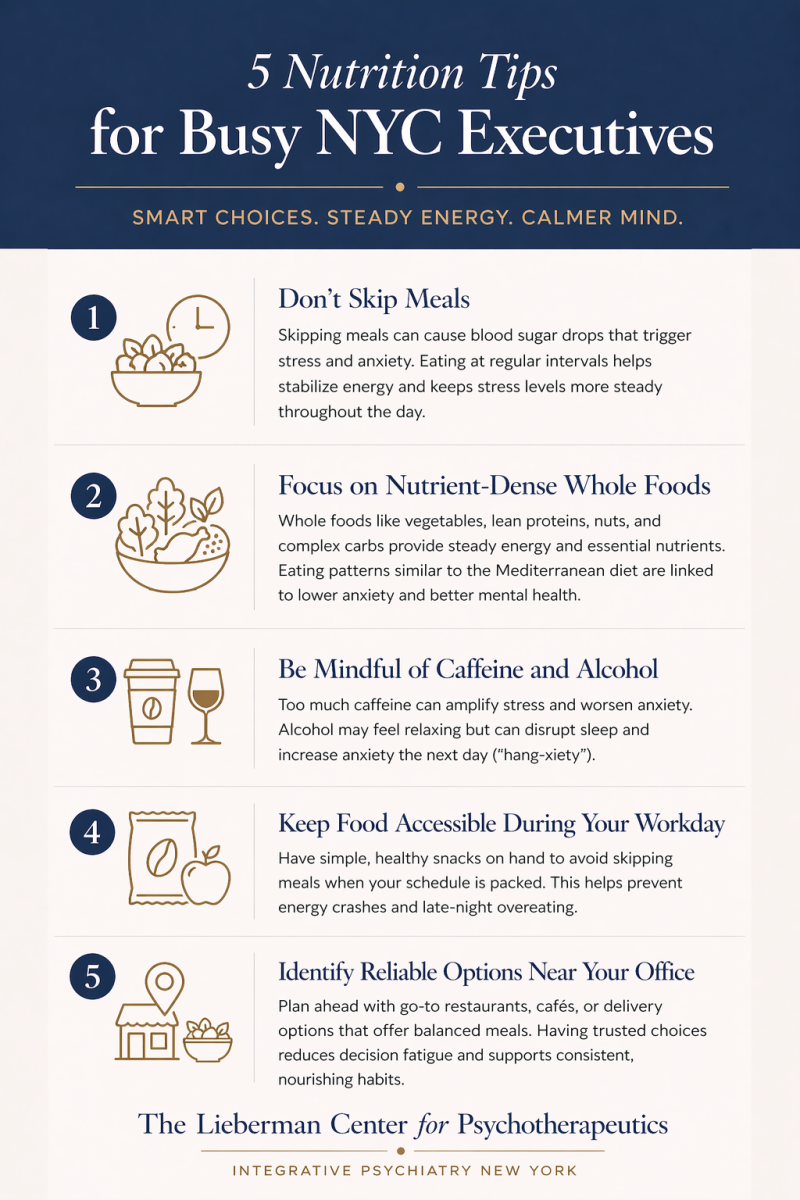
5 nutrition tips for busy NYC executives
If you’re working in a high-demand role, the goal when it comes to nutrition is not perfection. It’s more important to be consistent, even if you don’t achieve all of your nutritional goals overnight. Small adjustments to your diet can still have a positive effect.
Here are 5 nutrition tips specifically designed for busy executives and professionals in New York that may help reduce anxiety.
Comprehensive psychiatric care includes nutritional support. At The Lieberman Center for Psychotherapeutics in New York, our comprehensive psychiatric evaluations include bloodwork to determine whether nutritional deficiencies could be contributing to your symptoms. Schedule a free consultation today.
Don’t skip meals
Skipping meals is one of the most common patterns among busy professionals.
Even if you’re not consciously restricting food or “dieting”, long gaps between meals can lead to drops in blood sugar. That can trigger your stress response and increase anxiety symptoms throughout the day. It can also make it more likely you’ll overeat sugary foods at night, which can worsen your mood and anxiety even further.
Eating at regular intervals helps stabilize your energy and reduces the likelihood of sudden spikes in stress. As much as possible, try not to skip meals, even on your busiest days.
Focus on nutrient-dense whole foods
Diet quality matters more than any single food. It’s not so much about eating more of these specific things and less of those. It’s about adjusting your diet as a whole to make it easier to meet your nutritional needs.
In general, aim to eat more “whole” foods. Whole foods provide a more stable source of energy and a broader range of nutrients compared to processed foods. This includes vegetables, lean proteins, nuts, and complex carbohydrates.
Research suggests that dietary patterns similar to the Mediterranean diet are associated with decreased anxiety and improved mental health outcomes.
Be mindful of caffeine and alcohol
Busy professionals can tend to overrely on caffeine and alcohol — caffeine to get you through your day, and alcohol to wind down at the end of it.
There’s nothing necessarily “wrong” with starting your day with a cup of Joe. But it’s also important to understand that caffeine can amplify your stress response. In moderate amounts, it may improve focus. But with high intake, it can increase anxiety symptoms, especially in individuals who are already prone to anxiety.
Alcohol can have a similar effect in the opposite direction. It may feel like it helps you relax, but it can disrupt sleep and increase anxiety the following day (a phenomenon often called “hang-xiety”). Alcohol can also negatively affect your mood and put you at an increased risk of depression.
Keep food accessible during your workday
In NYC, your schedule can change quickly. Some days might be so filled with last-minute meetings that you don’t even have time to leave the office. If you don’t have food readily available, it becomes much easier to skip meals without realizing it. That often leads to long stretches without eating, followed by overeating later at night.
Keeping simple options at your desk or in your bag can make a big difference. This could be something small that you can eat between meetings or during a short break, like a granola bar or some veggie snacks.
Identify reliable options near your office
Your environment plays a major role in your diet, especially in a city like New York.
Instead of relying on whatever is closest when you’re exhausted, it can help to have a few go-to options that you already trust. That might be a nearby place where you know you can get a balanced meal, or a delivery option that feels realistic on a busy night.
This kind of planning reduces decision fatigue and makes it more likely that you’ll eat consistently, even when your schedule is demanding.
When to seek support
Improving your diet can support the management of anxiety, but it is not always enough on its own.
If you’re experiencing persistent anxiety symptoms, or if your mental health is affecting your ability to function, it may be time to consider additional treatment and support. Anxiety disorders, including generalized anxiety disorder or social anxiety disorder, often require a more comprehensive treatment approach.
You may benefit from working with a psychiatric provider if:
- Your symptoms of anxiety are consistent (you experience them nearly every day)
- They interfere with your work or personal life
- Your stress response feels difficult to control
- You’ve made dietary and other lifestyle changes, but continue to experience anxiety
Nutritional counseling can be one part of treatment for anxiety disorders, especially with an integrative psychiatric provider. But it tends to be most effective when integrated into a broader plan that addresses biological factors along with psychological patterns.
Contact the Lieberman Center for Psychotherapeutics: New York Integrative Psychiatry
At the Lieberman Center for Psychotherapeutics, we take an integrative approach to psychiatry that considers the role of diet and nutrition in mental health. Our comprehensive evaluations include lab panels and blood work to test for nutritional deficiencies (as well as psychiatric assessment).
We work with executives and other high-performing professionals across NYC, Long Island, and Westchester County. Our New York mental health clinics offer evidence-based treatment of anxiety disorders, depression, and more in discrete, concierge-style environments.
If you’re looking for a more comprehensive approach to managing anxiety, you can schedule a free consultation to discuss next steps.