

Around 3 in 4 people will go through a traumatic event at some point in their lives, and many of those people will develop post-traumatic stress disorder (PTSD).
But PTSD doesn’t always look like having intense flashbacks and being unable to go about your daily life. Many people living with traumatic stress are successful and accomplished, especially from the outside looking in. The term “high-functioning PTSD” is often used to describe this experience of coping with significant trauma symptoms while continuing to perform at a high level.
Start concierge-style trauma treatment in Garden City & Midtown, New York. Designed for high-functioning professionals.
What can PTSD look like in high-functioning professionals?
Many people, when they think about “PTSD,” imagine someone in clear and obvious distress. Maybe they’re an unhoused army veteran, or a survivor who can no longer leave their home.
But PTSD doesn’t always look like this. Some people are able to function despite their internal symptoms. You may not be missing work or falling behind in your career. But that doesn’t make your experience with PTSD any less valid.
Signs and symptoms
The Diagnostic and Statistical Manual of Mental Disorders (DSM) lists the official symptoms of PTSD. These include:
- Intrusive symptoms, such as unwanted memories, nightmares, or flashbacks
- Avoiding thoughts, feelings, people, or places connected with what happened
- Negative changes in your thoughts and mood, including guilt, emotional numbness, or feeling disconnected from other people
- Changes in arousal and reactivity, such as hypervigilance, irritability, difficulty concentrating, or an exaggerated startle response
To qualify for a PTSD diagnosis, symptoms must typically continue for more than one month and cause significant distress or interfere with an important area of your life. This interference may not be immediately obvious to the people around you.
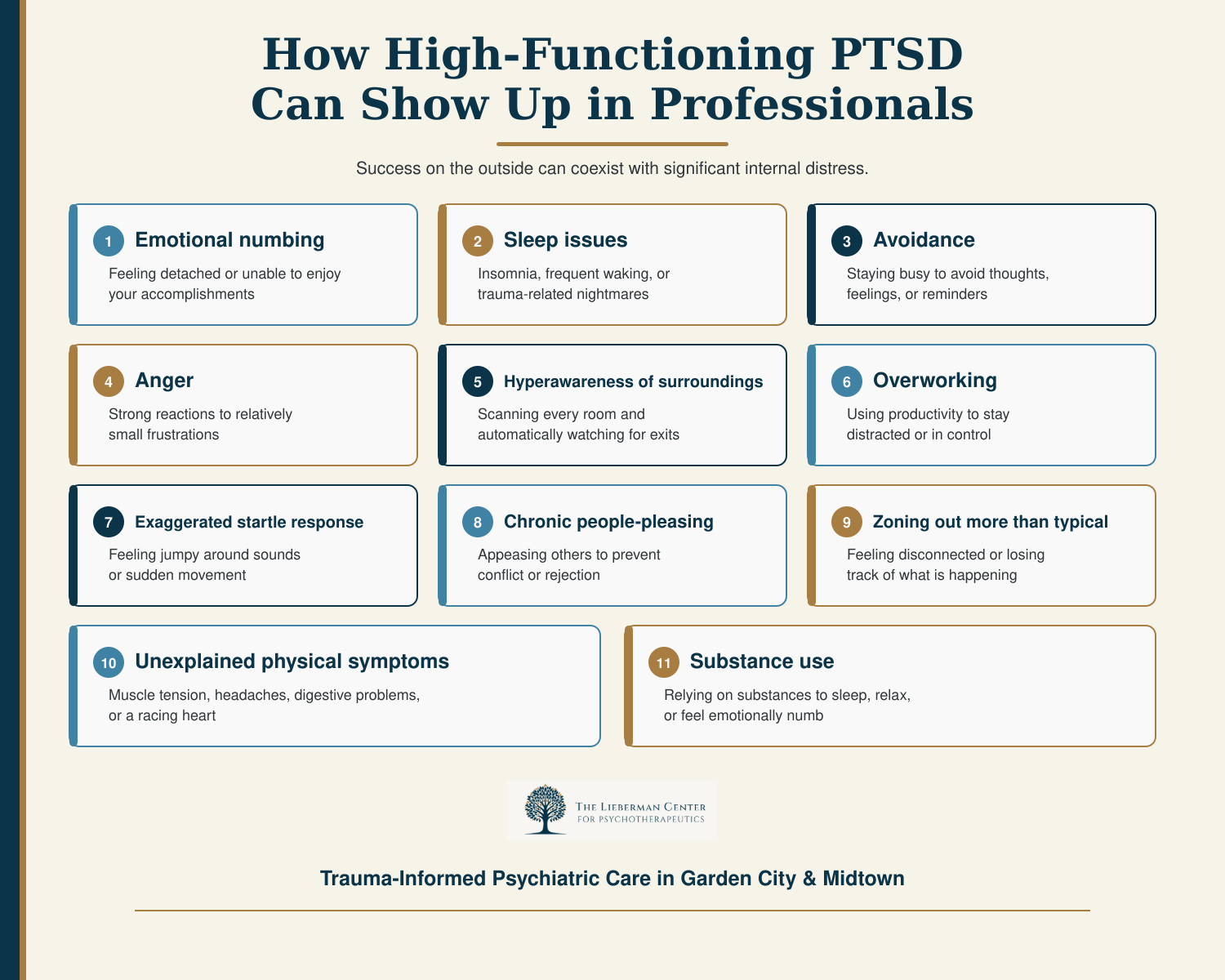
But traumatic stress can show up differently for different people. If you’re a high-functioning professional, the effects of trauma can look like:
Emotional numbing
This may be one of the top ways PTSD can present itself in high-functioning people. Instead of having flashbacks or reliving the event, you may experience numbness instead. You might go through the motions of your life without feeling fully present or find that you can’t experience joy or emotional closeness in the same way you once did.
Sleep issues
You may struggle to fall asleep because your body can’t relax, or wake frequently throughout the night. Some people have trauma-related nightmares, while others simply feel exhausted but unable to turn off their thoughts.
Avoidance
You may also go to great lengths to avoid thinking or talking about the traumatic event. When someone tries to talk to you about what happened, you brush them off or make a joke of it. You might also fill every moment of your schedule so you never have enough quiet time to think about what happened.
Anger
The effects of trauma can sometimes show up as unexplained or disproportionate anger. Anger itself is not a negative emotion, and it’s valid to feel angry about what happened to you. But sometimes, that anger might show up unexpectedly, like snapping at your partner or reacting intensely to a relatively small mistake at work.
Hyperawareness of your surroundings
You might find that you’re always on high alert, no matter where you are. You scan your surroundings or unconsciously look for the exit in every room.
Overworking
Many people with high-functioning PTSD throw themselves into work. Staying busy can give you a sense of control and prevent painful memories or emotions from catching up with you. Because overworking is often rewarded in competitive fields, the people around you may not recognize it as a sign that you’re struggling.
Exaggerated startle response
You might be “jumpy” or startle easily. When there’s a loud sound or someone sneaks up on you, you feel for a split second like you’re in danger. This can be a sign of trauma-related hypervigilance.
Chronic people-pleasing
One lesser-known trauma response (on top of fight, flight, and freeze) is fawn. This is when you try to prevent danger or conflict by appeasing the other person and putting their needs ahead of your own. Especially if you experienced repeated trauma in the context of an important relationship, you may have learned people-pleasing as a way to keep yourself safe.
Zoning out more than typical
Everyone zones out sometimes, but sometimes trauma can cause you to zone out more than typical. This could be a sign of dissociation. It’s a sign that your brain is needing a mental break from overwhelming emotions or reminders.
Unexplained physical symptoms
Trauma affects the body as well as the mind. You may experience headaches, digestive problems, muscle tension, chronic pain, or a racing heart without understanding why. It’s important to rule out medical causes, but physical symptoms can sometimes be connected with ongoing nervous system activation.
Substance use
You might rely on alcohol or other substances to sleep, relax, or feel emotionally numb. Even if your substance use hasn’t affected your professional reputation, needing it to get through the day or turn off at night can be a sign that you’re trying to manage untreated trauma symptoms.
Impacts at work
The very definition of “high-functioning” means that you’re able to continue to succeed in your life despite your symptoms. You may have a flourishing career in a competitive, high-stakes field. But that doesn’t mean that your PTSD doesn’t impact your work life at all.
- You might overprepare for every possible outcome because uncertainty makes you feel unsafe.
- Perfectionism can make it difficult to delegate, even when your workload has become unsustainable.
- Feedback or a colleague’s tone may feel threatening, which can lead you to become defensive or shut down.
- You may avoid certain assignments, locations, or professional events because they remind you of what happened.
- Poor sleep and hypervigilance can affect your memory or ability to concentrate during important meetings.
- You work through the day successfully but crash as soon as you get home.
- Even major accomplishments may feel emotionally flat. You know that you should feel proud, but you can’t connect with the feeling.
- Work becomes the one place where you feel competent and in control, so you devote more and more of your life to it.
Effects on relationships
High-functioning PTSD often shows up in relationships, even if you’ve been holding it together at work. Especially if you experienced attachment trauma (abandonment or abuse when you were a young child), this can continue to affect your adult relationships until you address it.
- You may find it difficult to trust other people, even when they’ve given you no reason to doubt them.
- Emotional numbing can make partners or family members feel like you’re distant or unavailable.
- You might avoid disagreement because any sign of conflict makes your body prepare for danger.
- Small misunderstandings can lead to intense anger, panic, or the urge to leave.
- Hyper-independence may prevent you from asking for help or allowing other people to care for you.
- You may constantly look for signs that your partner is going to reject or betray you.
- Physical or emotional intimacy can make you feel exposed, even when you want to feel close.
- Your relationships may receive whatever energy is left after work, which can leave the people closest to you feeling shut out.
The trauma response is biological, not a sign of weakness
If you take one thing away from this article, make it this: having PTSD is not a sign of weakness. Being “high-functioning” can be a sign of your resilience and determination. But it can also be a sign that you’re neglecting your true needs and pushing yourself farther than your nervous system can realistically sustain.
The trauma response is natural and biological. When you’re faced with a traumatic event, your brain and body automatically prepare to survive. Stress hormones are released, your heart rate may increase, and your nervous system moves into a fight, flight, freeze, or fawn response. This is especially true for prolonged trauma (like relational violence or childhood abuse).
Your brain also learns to recognize cues that were connected with the danger. Later, a sound, expression, physical sensation, or situation may activate your alarm system before the thinking part of your brain recognizes that you’re currently safe. With PTSD, that biological survival response can remain highly sensitive even after the original threat has passed.
What effective treatment looks like for high-functioning PTSD
Post-traumatic stress isn’t just something you need to swallow and live with for the rest of your life. You may have survived until now, but the impacts of trauma may still be affecting your life in ways you don’t realize. You deserve to thrive and live with ease, not just survive.
There are evidence-based treatments that can help you process and heal from trauma and PTSD. You may not forget what happened, but you can reduce the impact the trauma has on your current life.
Trauma therapy
The first-line treatment that’s most widely recommended for PTSD is psychotherapy, which is typically recommended above medication. Specifically, manualized trauma-focused therapies can help you process the trauma, reduce avoidance, and change beliefs that have kept you feeling unsafe.
Trauma therapy isn’t simply about revisiting painful memories without a purpose. A trained trauma therapist can help you build skills for managing difficult emotions and approach memories or reminders in a structured way.
Treatment should be collaborative and move at a pace that allows you to remain engaged without becoming completely overwhelmed. Some of the most effective therapy techniques for PTSD symptoms include:
- Eye movement desensitization and reprocessing (EMDR): EMDR involves thinking about aspects of the traumatic event while engaging in bilateral stimulation, such as guided eye movements. Over time, the memory may become less emotionally distressing.
- Cognitive processing therapy (CPT): CPT helps you identify and reconsider beliefs that developed after the trauma. These may include beliefs about blame, trust, control, or your ability to stay safe.
- Prolonged exposure: Prolonged exposure helps you gradually approach memories and safe situations that you’ve been avoiding. This can teach your brain that reminders of the trauma are not the same as the original danger.
Medication for trauma
Sometimes, medication can be a part of treatment, either to reduce PTSD symptoms themselves or to address related concerns.
There are two FDA-approved medications for PTSD, both antidepressants (SSRIs):
- Sertraline (Zoloft)
- Paroxetine (Paxil)
On top of these, different medications are often used off-label for:
- Anxiety and panic attacks
- Insomnia
- Nightmares
- Mood stabilization (reduction of irritability or angry outbursts)
The evidence and potential risks vary depending on the medication and the symptom being treated. A psychiatrist can look at your complete health history, current symptoms, other medications, and any co-occurring mental health conditions before making a recommendation.
Trauma-informed psychiatry in Garden City for high-performing professionals
At the Lieberman Center for Psychotherapeutics, we provide trauma-informed psychiatric care for professionals whose symptoms may not be visible from the outside. We take the time to understand how trauma may be affecting your sleep, physical health, relationships, and productivity.
Depending on your needs, treatment may include a comprehensive psychiatric evaluation, medication management, and collaboration with your trauma therapist.
Contact the Lieberman Center for Psychotherapeutics to learn more about trauma-informed psychiatry in Garden City or Midtown, New York. Our concierge approach is designed to provide thoughtful, discreet care that fits the realities of a demanding professional life.