

Search Reddit for tech burnout, and the same story keeps coming up again and again. “I didn’t expect to burn out in just 2 years of working in tech.” Another post: “Burnt out at big tech. Feel ungrateful even thinking it.” And yet another: “Anyone else feel completely trapped by their tech salary?”
According to some reports, over 80% of software developers experience burnout. It’s estimated that developer burnout may cost tech companies up to $1 trillion a year.
For tech workers in NYC, whether you work at a small startup or in Big Tech, burnout can be especially intense. The cost of living is high, and the job market is competitive.
It shouldn’t be “normal” to feel like this, and knowing the symptoms of tech burnout can help you take action.
Why is burnout so common in tech?
Burnout isn’t a sign that tech professionals are more fragile or flaky than anyone else. It’s not about a lack of motivation. Burnout speaks to larger industry issues of overwork and poor work-life balance.
The root causes of burnout in the tech industry are usually structural — meaning they’re built into how these tech roles are designed. But there can also be personal factors that can increase your individual burnout risk.
Organizational and structural factors
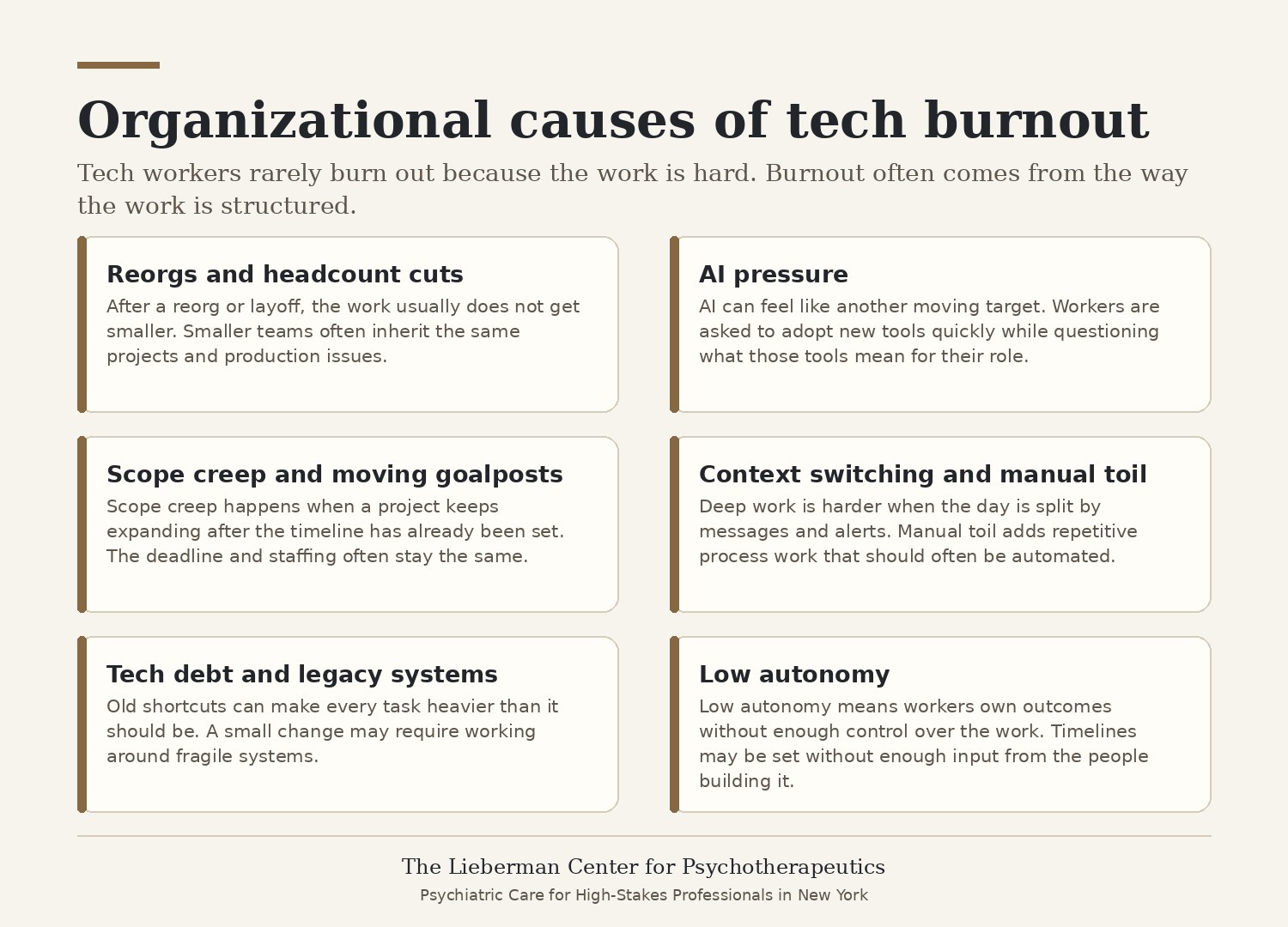
So many tech environments create the very conditions that burnout grows from. Tech employees don’t burn out because the work is too hard. You’re equipped to deal with hard problems. You may have even gotten into the industry to begin with because you like solving hard problems.
Usually, the structural causes of burnout have more to do with everything around the work itself. Long hours and poor work-life balance play a role, just like they do in every high-pressure career. But tech worker burnout is linked to specific challenges that are unique to this field.
Reorgs and layoffs
Over 160,000 tech workers have been laid off in just the first seven months of 2026. It’s hard to continue feeling good about your work when you’re always afraid your position is the next to be cut.
In addition, after a reorg or layoff, the work usually does not get smaller. The team just has fewer people to carry it. So even if you survive a round of layoffs, you may be punished by being overloaded with more work.
It can also start to feel like you’re managing optics instead of just doing the job. You feel like you not only need to do the work, but you need to make sure that everyone knows you’re working hard.
AI pressure
In today’s world, the pressure to keep up with AI is real. The problem is that AI seems like a constantly moving target. You may be told to adopt new tools quickly while still keeping up with the same workload. At the same time, you’re worried about what AI means for your role.
That creates pressure on both sides. You have to keep shipping, but you also have to keep proving that your work still matters. Even when AI is useful, the rollout can feel rushed and poorly supported.
Scope creep and moving goalposts
You may also feel like the goals and scope of projects are constantly moving, even when the deadline stays the same. Often, it means that you’re expected to complete a more complex project in the same amount of time (and with the same staffing resources).
This can make planning feel pointless. You’re still expected to deliver, even when the original agreement no longer matches the actual work. It makes sense that you would feel defeated before a project even begins.
Context switching
Tech work often requires long periods of uninterrupted focus. That becomes difficult when someone is moving between code review, Slack threads, incident alerts, and product questions all day. Even small interruptions can interrupt your flow and make complex work take much longer.
Tech debt and legacy systems
Many tech professionals are working within systems that they didn’t have a say in building. Technical debt can make every task more annoying and time-consuming than it should be. A small change may require working around old decisions that no one has time to clean up. Legacy systems can also make simple fixes feel unnecessarily risky.
It’s hard to feel effective when you’re expected to move fast inside an outdated system. It can start to feel more like you’re constantly doing damage control than anything innovative.
Low autonomy
Many tech workers are given very little control over the work they do. You may have to own the outcome without owning the timeline. Low autonomy can show up when engineers are responsible for delivery, but timelines are set without enough input from the people doing the work. You may also be asked to defend decisions you did not make.
Leadership might also make product or architecture decisions without addressing the tradeoffs. As an engineer, you may be asked to pivot and produce quickly while also maintaining quality, even when the roadmap isn’t realistic.
Personal factors
Personal factors can affect burnout, but they do not make burnout your fault. But there might be some things about your unique personality or history that make you more vulnerable.
These factors include:
- Being perfectionistic or highly conscientious
- Being a people-pleaser or having a hard time disappointing people
- Tying your self-worth to your productivity
- Feeling pressure to prove yourself because of your identity (in tech, this may be because you’re a BIPOC or a woman)
- Living with mental health or neurodevelopmental conditions like depression, anxiety, or ADHD
- Not having interests or relationships outside of work
- Staying in your role purely because of salary or benefits, not because you have any interest in tech
Tech burnout symptoms and warning signs
Knowing the signs of burnout can help you deal with it earlier on. It might not look like what you expect, especially as a tech worker. Burnout can look different in tech because the work depends so much on concentration. You may not fall apart all at once or feel like you’re having a “breakdown.” It might just look like slowly becoming more and more resentful of the work.
Common tech burnout warning signs include:
- You dread opening Slack or Jira before the workday starts. At the same time, you can’t stop yourself from checking it even after you’ve clocked out.
- You feel mentally foggy when trying to work, which makes it more time-consuming to code or debug.
- You avoid asking questions because you worry that everyone else is ahead of you.
- You feel angry when requirements change, even when the change is reasonable. Sometimes, you lash out at your colleagues or loved ones at home.
- You’ve stopped participating in meetings. It feels like your contributions don’t matter anyway.
- You rely on panic or late-night work to finish tasks.
- You feel trapped in your current role by salary, health insurance, equity, or visa concerns.
- You fantasize about leaving tech completely, even if you once loved the work.
- You feel guilty when you think about how unhappy you are. You feel you should be grateful for your salary or position. So you push the feelings down.
- You feel detached from your team and stop caring about outcomes that used to matter. You feel like your life no longer belongs to you (also called depersonalization).
- You don’t recover during evenings or weekends. Monday always feels like it arrives too soon.
- You keep performing on the outside while feeling empty inside. You feel that no one on your team can tell how much you’re struggling.
How to prevent and recover from burnout in the tech industry
Like most other industries, avoiding burnout in tech requires a broader conversation about how these companies are designed. Individual coping skills can help, but they cannot compensate for chronic understaffing or mass layoffs.
If you work in tech and are trying to recover from burnout, you may need practical change, not just a mindset shift. For example, you may need a different team or manager. In some cases, you may need a new company.
But you also need to take care of the stress that has built up in your body. It can help to get some clarity about what, exactly, is harming you before you make a major decision from a place of panic or resentment.
Here are some actionable strategies that may help you reduce burnout.
- Name the specific source of burnout. “I hate tech” may be true, especially in the moment. But it may also hide a more specific problem, such as layoffs or poor management. What, exactly, about your current position are you unhappy with?
- Separate your ability from your current role. Burnout can make skilled people believe they are suddenly bad at work. Feeling this way doesn’t mean you’re bad at what you do.
- Reduce hidden work where you can. Ask for written priorities or fewer unnecessary meetings. These tasks can take up a lot of time, but you still might not feel like you accomplished anything at the end of the day.
- Protect deep work time. Your brain needs blocks of uninterrupted focus to feel competent again. Let your team know you’re turning off your Slack notifications, if possible. Schedule these blocks into your day.
- Take care of your body. Get good sleep. When you don’t get enough sleep, stress worsens. The same goes for not exercising enough. Nourish your body. Don’t overrely on meal replacements and energy drinks.
- Rebuild a life outside work. Consciously spend time not being productive or trying to improve. Spend time with people in different careers who have better work-life balance.
- Make career decisions slowly when possible. A new role may really help. But when you’re burned out, every move feels urgent. Take your time to weigh the benefits vs. risks of leaving your current position.
- Get mental health support if your symptoms are getting worse. A mental health professional may not be able to fix the fundamental structural issues that are so prevalent in the tech field. But they can help you deal with perfectionism or avoidance. It can also help with things like work trauma or the fear of leaving a prestigious role.
Mental health treatment for high-achieving tech workers in NYC
High-achieving tech workers often wait too long to seek help because they can still succeed and be productive. But being functional at work is not the same as being truly well. You don’t need to live with this level of emotional exhaustion day after day.
At The Lieberman Center for Psychotherapeutics, we work with high performers in NYC, like tech professionals, who are carrying intense work pressure. Integrative psychiatry can help you get to the root of burnout and build a more sustainable relationship with your career. We can also address underlying mental health concerns that may be contributing to the problem.
A comprehensive evaluation with us may include a blood panel, a psychiatric assessment, genetic testing, and more.
Book a free 15-minute consultation today to learn how we can help you.