

The burnout rate among U.S. physicians has dropped since pandemic levels, but it still reflects a crisis. According to some reports, over half of physicians are facing problems of serious burnout and emotional distress.
Physician burnout is often discussed as if it were a personal stress problem. But framing the problem in that way misses the depth of what’s actually happening.
As a physician, you were trained to keep functioning. That discipline is part of what has helped you succeed when many others would have given up. But pushing through burnout using sheer willpower and endurance isn’t sustainable. You deserve a real solution.
The Lieberman Center for Psychotherapeutics provides concierge psychiatric services for physicians and other high-stakes professionals in New York. Book a free consultation today.
Important physician burnout statistics
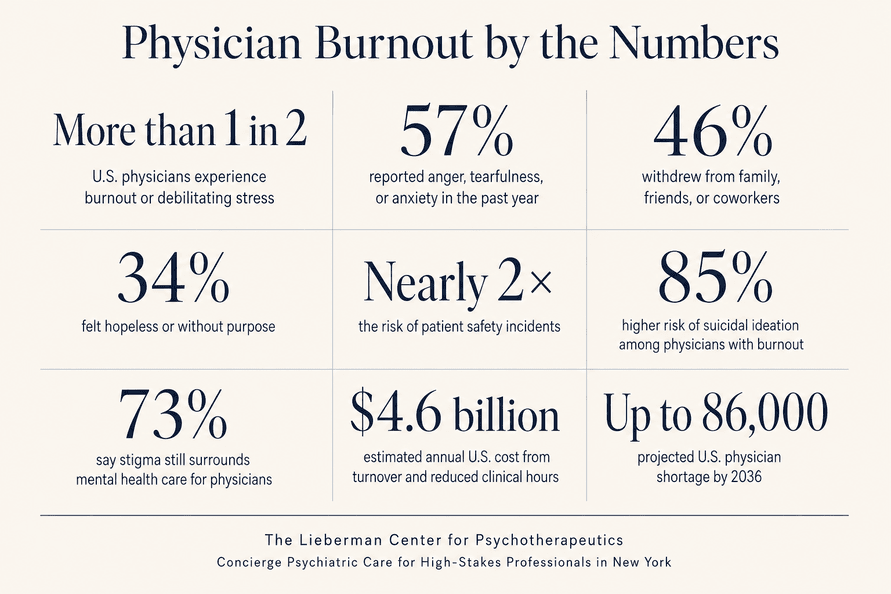
The numbers behind physician burnout speak for themselves. Clearly, this is a serious structural problem, not a weakness in individual physicians.
- Over 1 in 2 physicians in the U.S. experience feelings of burnout or debilitating stress.
- 57% of physicians report inappropriate feelings of anger, tearfulness, or anxiety in the past year.
- Nearly half of physicians, 46%, said they had withdrawn from family, friends, or coworkers.
- More than one-third of physicians, 34%, reported feeling hopeless or that they had no purpose.
- Physician burnout directly affects the quality of patient care. It nearly doubles the risk of patient safety incidents.
- Physicians facing burnout have an 85% increased risk of suicidal ideation.
- 73% of physicians agreed that stigma still surrounds mental health care among physicians.
- Physician burnout costs the United States an estimated $4.6 billion each year through turnover and reduced clinical hours.
- The Association of American Medical Colleges projects that the United States could face a physician shortage of up to 86,000 physicians by 2036.
What are the signs of physician burnout?
Burnout in medicine can involve emotional depletion and a growing sense of helplessness. When it’s left unaddressed, it can affect your judgment, your relationships, your health, and even — unfortunately — your ability to keep doing this important work safely.
Physician burnout can look different from what it does for other professionals (such as financial advisors or attorneys). Because of the nature of the profession, many physicians continue to perform at a high level long after many others would have stepped away. Even though you may look composed to patients and colleagues, internally, you may feel disconnected, irritable, numb, and resentful.
Some symptoms of burnout in physicians include:
- Becoming more cynical about patients, administrators, or the medical system overall
- Feeling dread before you go into work in the morning, or before clinic, call, rounds, or the operating room
- Losing the sense that your work has meaning
- Feeling trapped by documentation, patient messages, billing requirements, or productivity targets
- Having less patience with the people around you, including residents, nurses, staff, patients, or family members
- Making more administrative or medical errors due to emotional exhaustion or lack of focus
- Having less confidence in the operating room or when making important clinical decisions
- Ruminating about cases long after you leave the hospital or office
- Withdrawing from family because you have nothing left to give at home
- Feeling emotionally detached after bad outcomes or patient deaths
- Depersonalization, or feeling like your life is no longer your own
- Using alcohol, sedatives, stimulants, or other substances to get through the workday or come down after it
- Thinking about leaving medicine
- Having fantasies about disappearing or even ending your life to escape
Especially for physicians in acute-care specialties, burnout can also involve a state of chronic vigilance. You may leave work physically, but part of your mind remains on call. Over time, that level of nervous system activation can make it harder to sleep, think, make decisions, or feel present.
Leading causes of burnout in physicians and surgeons
Every physician’s individual risk for burnout is tied to a combination of personal and system-level pressures. It’s not just about your individual resilience to stress. No matter how resilient you are, that cannot compensate for what you’re dealing with on a daily basis.
Here are some of the main causes that contribute to burnout among U.S. physicians specifically.
Administrative burden
Many physicians spend a large part of the day on work that does not feel clinically meaningful. This can include:
- Electronic health record documentation
- Prior authorizations
- Patient messages
- Insurance forms
- Billing requirements
- Quality reporting
This work can extend the clinical day into evenings and weekends. Many physicians feel that quality patient care has become secondary to documentation and regulations.
Loss of autonomy
Physicians need autonomy to use their clinical judgment. This includes the ability to decide how much time to spend with a patient, what questions to ask, what tests to order, and how to approach building a treatment plan.
Modern medicine often limits that autonomy. Reimbursement rules, documentation demands, productivity targets, and system protocols can make physicians feel like they are working inside a “fixing people production line,” as one author put it.
You entered the profession expecting to use your judgment through direct patient care and consultation with colleagues. But now, you find yourself spending less time with each patient and more time managing administrative pressure.
Excessive workloads
Heavy workload is one of the clearest contributors to physician burnout. Long working hours, including call coverage, can leave physicians with not enough time to recover between shifts to perform at their best. Some studies found that, as a whole, physicians average around 6 hours of sleep per night.
But while long work hours are definitely a factor, they don’t fully explain the problem. Research has found that physicians have nearly twice the rate of burnout compared with people in other professions, even after accounting for work hours and other factors.
Moral distress
Moral distress can happen when you know what a patient needs, but can’t provide it because of system constraints. This may involve things like:
- Insurance denials
- Lack of access to specialty care or equipment
- Delayed treatment due to high patient load
- Pressure to discharge patients before it feels clinically appropriate
For physicians and surgeons, moral distress can be especially painful because medicine is built around an ethical duty. You took an oath to do no harm. But when the system repeatedly blocks good and often life-saving care, you may begin to feel complicit in harm you did not choose.
Secondary trauma and chronic exposure to suffering
Physicians are exposed to illness, fear, pain, and death as part of routine practice. Many have learned to compartmentalize this exposure because the work requires it.
Compartmentalization can be useful, and even necessary, in the moment. But it can lead to burnout and other mental health concerns when you have no time to process what has happened. Secondary trauma is a real emotional phenomenon that affects people in all helping professions. It needs to be taken seriously.
This can be especially relevant for surgeons, pediatric hospice workers, and other physicians where there is a greater loss of life. A complication can feel personal even if you didn’t make any mistakes. The psychological weight of that responsibility may stay with you and develop into burnout over time.
Stigma around mental health care
Many physicians worry that seeking mental health treatment, and being diagnosed with a mental health condition, could affect things like licensure, credentialing, hospital privileges, malpractice coverage, or reputation.
Even though these fears are not legally justified, that doesn’t mean that physicians are fearful for no reason. Medical boards in many states ask intrusive questions about your mental health history. And even if that weren’t true, the stigma itself can still keep physicians from getting the care they need.
This is especially true in an already stressed-out city like New York, where many physicians work in competitive hospital systems and academic settings. All physicians should be able to get confidential mental health care without fear that it will damage their careers.
Physician burnout solutions: What can we do to address it?
Burnout cannot be solved by asking physicians to become more resilient while leaving the same problems in place. As a physician, you do not need to accept this level of distress as “normal” or inevitable in the field of medicine.
A real solution requires a dramatic cultural change. Physicians need reasonable workloads and more control over their time. They need less administrative work that pulls them away from actual patient care.
Other useful organizational changes may include:
- Reducing unnecessary documentation
- Improving staffing
- Protecting time for sleep and recovery between shifts
- Giving physicians more input into workflow and treatment decisions
- Regularly measuring burnout at the organizational level
- Training hospital leaders to respond to physician distress
- Making confidential mental health care easier to access
- Removing intrusive mental health questions from licensing processes
But individual interventions can still make a difference. Psychiatric treatment, peer support, coaching, and simply getting enough rest can help prevent burnout.
But these interventions work best when they are paired with real changes in the work environment.
Obviously, this is a larger conversation than one article can address fully. But the starting point is clear: physician burnout should be treated as a serious occupational health issue, not as a personal failure.
Concierge psychiatric services for New York physicians
Physicians and surgeons need mental health care that respects the complex nature of their work. We’re here to challenge the myth that suffering is proof of your commitment to your field. The world needs emotionally steady physicians. It does not need physicians who are too exhausted to perform at their best.
At The Lieberman Center for Psychotherapeutics, we offer confidential and sophisticated psychiatric treatment that is tailored for high-functioning professionals who may look composed on the outside while carrying significant internal distress.
Our cutting-edge approach to physician well-being may include a comprehensive psychiatric evaluation (including labwork), evidence-based psychotherapy, medication management when appropriate, sleep and stress physiology support, and deeper insight into your allostatic load.
To protect your privacy more fully, we choose not to work with insurance companies. That means your psychiatric records will stay within our practice.*
Book a free 15-minute consultation to get started.
*Confidentiality exceptions apply when you are a risk to yourself or another person, or if the clinician has reasonable suspicions of child or elder abuse or if you elect to use out-of-network benefits for reimbursement submission to your insurance company.